
ESP32-S3-Nano Microcontroller
5.0Editor score
16MB Flash Memory Storage
Switchable Arduino and Python
Low Cost Development Solution
This guide compares the top Arduino Nano ESP32 boards for IoT, wireless connectivity, and embedded development to help you choose the right model.
The Arduino Nano ESP32 represents a significant leap in embedded development, combining powerful processing with modern wireless connectivity. This compact board brings high-performance computing to makers who need reliable Wi-Fi and Bluetooth in a small form factor for various projects.
We evaluated ten leading microcontroller options based on performance, connectivity features, and community support. Each product was analyzed for its processor speed, memory capacity, and ease of use to ensure you find the best fit for your specific application needs.
Every selection below highlights unique strengths like battery management, security features, or specialized interfaces. Please note that pricing fluctuates frequently, so verify current costs before purchasing to ensure you get the best value for your investment today.
5.0Editor score

4.6Editor score

4.7Editor score
This side-by-side comparison breaks down the technical specifications and key features of every board to help you make an informed decision based on your project requirements.


The Arduino Nano ESP32 stands out as the premier choice for developers seeking official support combined with modern wireless capabilities. It scores a robust 4.6 rating from users who appreciate its balance of power and usability in embedded systems.
We may earn a commission when you buy through this link, at no additional cost to you.
Its ESP32-S3 processor delivers exceptional speed at 240 MHz, enabling complex tasks like voice recognition and edge machine learning. The dual-core architecture ensures smooth multitasking while the integrated Wi-Fi and Bluetooth 5.0 simplify connectivity for smart home applications.
While it is pricier than generic modules, the stability and documentation justify the cost for professional projects. The USB-C port eliminates cable clutter and ensures faster upload times which is crucial for rapid prototyping phases.
This board is ideal for makers who need reliable hardware without spending hours troubleshooting firmware issues. If you value long-term support and high-speed wireless communication, this is the definitive board to buy today.
The board supports both Wi-Fi and Bluetooth 5.0 enabling seamless communication with other devices networks and cloud platforms for various applications.
MicroPython compatibility allows for rapid prototyping and educational projects making it easier for developers to use Python over C plus C.
We may earn a commission when you buy through this link, at no additional cost to you.
This microcontroller offers a compelling entry point into the ESP32 ecosystem with a perfect 5.0 rating from satisfied users. It balances cost and performance effectively making it a favorite for budget-conscious students and hobbyists.
We may earn a commission when you buy through this link, at no additional cost to you.
The onboard ESP32-S3R8 chip provides ample memory with 16MB Flash and 8MB PSRAM which is rare at this price point. Support for both Arduino IDE and MicroPython gives users the flexibility to switch programming environments without hardware changes.
Although it lacks the official branding, the feature set rivals more expensive boards. The HID emulation feature is particularly useful for building custom input devices like keyboards or mice without needing additional hardware.
Buyers looking for high memory and dual OS compatibility will find this board hard to beat. It is a smart choice for projects where cost efficiency is paramount but performance cannot be sacrificed.
Integrated 8MB PSRAM and 16MB Flash memory provide ample space for complex applications and data logging without external storage needs.
Seamlessly switch between Arduino and MicroPython programming to accommodate different skill levels and project requirements easily.
We may earn a commission when you buy through this link, at no additional cost to you.
The Arduino UNO R4 WiFi introduces a unique dual-core architecture combining a Renesas MCU with the ESP32-S3 for unmatched versatility. With a 4.7 rating it appeals to advanced users needing industrial-grade interfaces and visual feedback.
We may earn a commission when you buy through this link, at no additional cost to you.
Features like the 12-bit DAC and OP-AMP allow for precise analog signal generation which is rare in standard microcontrollers. The integrated LED Matrix enables immediate visual feedback making it perfect for interactive displays and status indicators.
While it is the most expensive option the inclusion of CAN bus support opens doors for automotive and robotics applications. The Qwiic connector simplifies wiring for sensors which reduces setup time significantly for complex prototypes.
If you need a board that bridges the gap between simple hobby projects and industrial applications this is the best choice. Its robust feature set justifies the investment for serious engineering tasks.
The built-in 12×8 LED Matrix allows users to display dynamic visuals messages or real-time data on the board itself.
Controller Area Network support allows for reliable real-time communication in industrial automotive or robotic systems.
We may earn a commission when you buy through this link, at no additional cost to you.
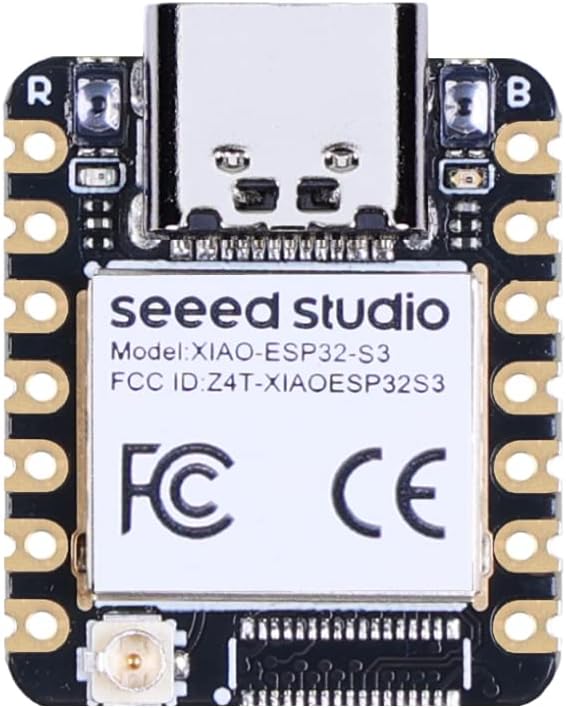
This thumb-sized board is engineered specifically for space-constrained wearable devices with a 4.7 rating from makers building portable tech. Its compact size allows it to fit in tight enclosures where standard boards cannot go.
We may earn a commission when you buy through this link, at no additional cost to you.
The battery charge management capability simplifies designing battery-powered projects significantly. Deep sleep modes consume as low as 14 microamps ensuring long operational times without frequent recharging cycles.
Users note that while it has fewer pins the power efficiency compensates for most wearable use cases. The U.FL antenna support extends range significantly which is vital for remote sensing applications.
For anyone designing smartwatches fitness trackers or portable sensors this is the optimal hardware. Its power efficiency makes it superior for long-term battery-operated deployments.
Offers 4 power consumption models allowing for deep sleep mode with power consumption as low as 14 microamps.
The 21 by 17.5mm design adopts the classic form factor suitable for space limited projects like wearable devices.
We may earn a commission when you buy through this link, at no additional cost to you.
The ESP32-P4-NANO targets advanced developers needing visual data processing capabilities with a 4.8 rating for its specialized performance. It distinguishes itself with dedicated image and voice processing hardware that supports complex AI tasks.
We may earn a commission when you buy through this link, at no additional cost to you.
RISC-V dual-core processors provide high-speed performance while the onboard MIPI-CSI interface allows direct camera integration. The massive memory configuration ensures smooth handling of large image data without external dependencies.
Security features like secure boot and flash encryption add robustness for commercial applications. However the complexity of interfacing may challenge users unfamiliar with low-level hardware configurations.
This board is essential for robotics or smart camera projects requiring local AI inference. If your project needs visual recognition this hardware offers unmatched native support.
Provides image and voice processing interfaces including JPEG Codec Pixel Processing Accelerator Image Signal Processor H264 encoder.
Includes MIPI-CSI MIPI-DSI USB 2.0 OTG Ethernet and SDIO 3.0 TF card slot for versatile peripheral connections.
We may earn a commission when you buy through this link, at no additional cost to you.
This bundle offers a cost-effective solution for production runs with a 4.4 rating from users building multiple units. The castellated edges allow direct soldering to carrier boards which simplifies integration into custom PCBs.
We may earn a commission when you buy through this link, at no additional cost to you.
The onboard ceramic antenna provides reliable wireless performance without needing an external module. Independent power control allows you to optimize energy usage for different operating scenarios which helps extend battery life.
While it requires some soldering skill the flexibility it offers for custom designs is valuable. Users appreciate the consistent performance and the convenience of getting three boards in one package.
Ideal for small batch manufacturing or projects requiring multiple nodes this board balances cost and functionality well. It is a practical choice when scaling beyond a single prototype.
The castellated module and onboard ceramic antenna allows soldering directly to carrier boards for custom integration.
Supports flexible clock module power supply independent setting and other controls to realize low power consumption.
We may earn a commission when you buy through this link, at no additional cost to you.
This kit transforms learning electronics with a 4.3 rating from students mastering IoT concepts. It includes over 35 different modules and components providing everything needed to explore a vast range of projects in one box.
We may earn a commission when you buy through this link, at no additional cost to you.
The detailed tutorial guide with 30+ projects offers complete code and clear circuit diagrams. Beginners can jump right in and learn the fundamentals without prior experience making it highly accessible.
While the included board uses Bluetooth 4.2 the comprehensive nature of the kit outweighs this limitation for new users. It removes the guesswork of sourcing parts which saves time and effort.
Perfect for educators or beginners needing a complete solution this kit is unmatched for foundational learning. It sets a strong basis for future development work.
Jump right in with detailed beginner-friendly tutorials accessing 30+ projects with complete code and clear circuit diagrams.
This kit contains over 35 different modules and electronic components including sensors displays motors and input devices.
We may earn a commission when you buy through this link, at no additional cost to you.
This board focuses heavily on security with a 4.5 rating from enterprise users needing protected data transmission. The inclusion of a Secure Element enhances project security by providing hardware-level encryption for all data.
We may earn a commission when you buy through this link, at no additional cost to you.
Users find it ideal for smart home systems where privacy is paramount. The pre-soldered headers make it easy to connect to breadboards which accelerates development timelines significantly.
While the processor is slower than newer options the efficiency is sufficient for most sensor applications. The strong community support ensures that help is available for any implementation issues.
For secure cloud-connected applications this board remains a trusted standard. If data integrity is your main concern this is the most reliable option available.
The inclusion of a u-blox ATECC608A Secure Element ensures secure cloud communication and data privacy for IoT deployments.
Equipped with WiFi and BLE this board enables seamless connection to the cloud mobile apps and other IoT devices.
We may earn a commission when you buy through this link, at no additional cost to you.
The ESP-WROOM-32 is a classic choice for IoT developers with a 4.4 rating due to its proven track record. It supports AP and STA modes allowing flexible network configuration for various connectivity scenarios.
We may earn a commission when you buy through this link, at no additional cost to you.
Users rely on its ultra-low power consumption for battery projects where longevity is critical. The dual-mode WiFi ensures stable connectivity across different network types which reduces connection dropouts.
While it lacks newer features like USB-C it remains stable and reliable for simple tasks. The affordable price point makes it a low-risk option for testing concepts before upgrading to premium boards.
It is the best option for standard IoT nodes where cost and reliability outweigh advanced features. If you need a workhorse board this model delivers consistent performance.
Support three modes AP STA and AP+STA which provides flexibility for different connectivity configurations and scenarios.
ESP32 is a safe reliable and scalable solution suitable for a variety of applications and environments.
We may earn a commission when you buy through this link, at no additional cost to you.
This bundle upgrades the classic design with a USB-C port rated 4.7 by users needing faster upload speeds. The modern connector aligns with current standards making cable management simpler and more durable.
We may earn a commission when you buy through this link, at no additional cost to you.
Over-the-Air update support allows you to update firmware over Wi-Fi without physical reconnection which is crucial for deployed devices. The dynamic clock scaling helps reduce energy use significantly in battery applications.
While it maintains older Bluetooth standards the USB-C and OTA features add significant modern convenience. The bundle price makes it an excellent value for testing multiple nodes in a network.
For users needing a blend of classic stability and modern connectivity this board is a strong contender. It is particularly useful for mesh network prototyping.
Connect through USB-C for power sketch uploads and serial monitoring while GPIO interfaces support sensors and displays.
Configure OTA functionality to update deployed firmware over Wi-Fi without reconnecting the board by USB for every revision.
We may earn a commission when you buy through this link, at no additional cost to you.
Selecting the right microcontroller involves balancing performance, connectivity, and budget. This guide outlines key factors to consider.
Processor speed and core count determine how fast your device handles data. Look for dual-core chips running at 240 MHz for demanding applications like image processing.
Prioritize higher MHz and dual cores for complex tasks to ensure smooth operation.
Wi-Fi and Bluetooth versions affect range and power consumption. Bluetooth 5.0 offers better range and speed compared to older 4.2 versions.
Choose boards with the latest wireless protocols for better performance and battery life.
Flash and SRAM determine how much code and data the board can hold. More memory is crucial for logging data or running complex libraries.
Ensure the board has at least 16MB flash for future-proofing your projects.
Power efficiency is vital for battery-operated devices. Features like deep sleep modes and efficient voltage regulators extend battery life significantly.
Look for low-power modes if your device needs to run for months on a single charge.
The types of pins available affect what sensors you can connect. Some boards offer specialized interfaces like I2C or CAN for industrial use.
Match the board pins to your sensor needs to avoid adding extra adapters.
Official support ensures better documentation and stability. Boards supporting multiple languages like MicroPython offer more flexibility.
Choose boards with active community support to simplify troubleshooting.
The size of the board impacts where you can install it. Compact boards are better for wearable or portable projects.
Select a size that fits your enclosure constraints without sacrificing essential ports.
Secure elements and encryption protect your data from unauthorized access. This is critical for commercial or privacy-sensitive projects.
Check for hardware security features if you are handling sensitive data.
Begin by installing the latest drivers and IDE on your computer to ensure compatibility with your board. Connect the device via USB-C to verify the connection before writing any code.
Always handle the board by the edges to avoid static discharge which can damage sensitive components. Store unused boards in anti-static bags to prevent degradation over time.
Monitor power levels regularly to avoid voltage spikes that could corrupt data or damage the chip. Use a stable power source rather than unreliable USB ports for production devices.
The Arduino Nano ESP32 features an ESP32-S3 chip with faster processing and modern USB-C connectivity. In contrast the Nano 33 IoT uses a SAMD21 chip focused on secure cloud integration with older connectivity standards.
Yes several boards like the official Arduino Nano ESP32 support MicroPython natively. This allows you to write code in Python which is often easier for beginners than C plus C.
The Seeed Studio XIAO ESP32S3 typically offers the best battery life due to its optimized deep sleep modes. It consumes as little as 14 microamps when sleeping which extends runtimes significantly.
Most of these boards come with onboard antennas sufficient for indoor use. However models with U.FL connectors allow you to add external antennas for longer range requirements.
Yes if you need advanced features like the built-in LED Matrix or CAN bus support. These capabilities make it more versatile for industrial or complex display projects.
You can enable OTA updates on supported boards like the ELEGOO ESP-32. This allows you to send new code wirelessly instead of using a USB cable for every change.
The Arduino Nano ESP32 leads as the top pick for its balanced performance and official support. The ESP32-S3-Nano offers the best value for budget projects while the UNO R4 WiFi stands out for advanced features.
Prioritize your specific needs like power efficiency or memory capacity before buying. Ensure the board matches the interface requirements of your sensors and project scope.
Check current prices on the links provided as they may fluctuate daily. Investing in the right board ensures your project remains stable and scalable for the future.