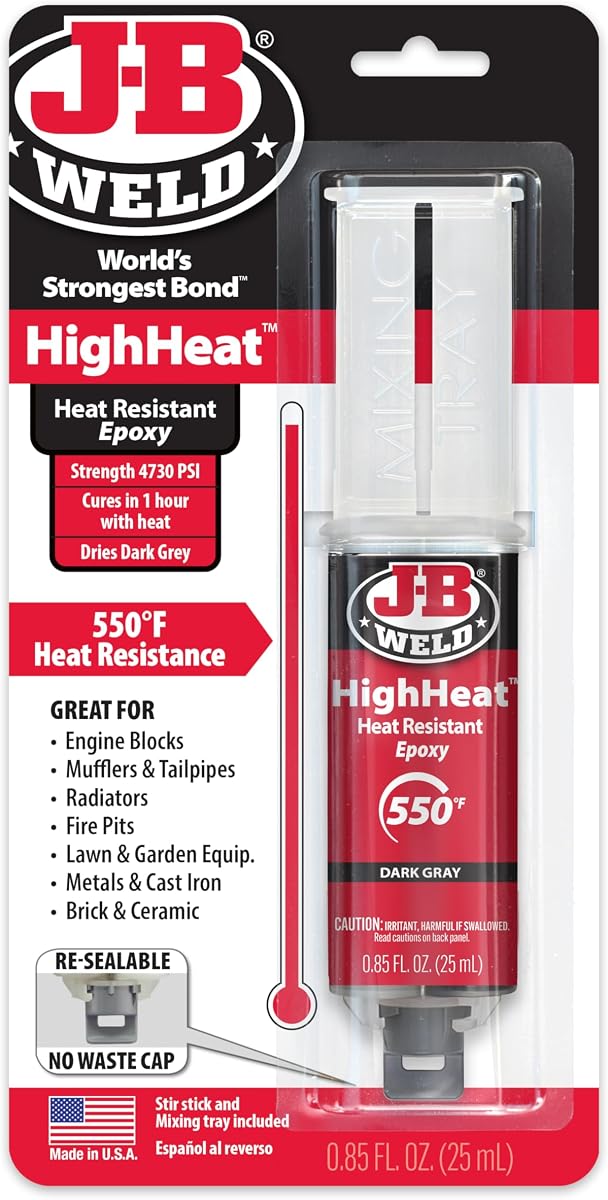
J-B Weld High Heat Epoxy Syringe, Dark Grey
4.6Editor score
Sets in one hour at room temp
Chemical and fuel resistant bond
Permanent 4730 PSI strength
This guide compares the top ten heat resistant adhesive options for high-temperature applications across ovens, automotive parts, and industrial equipment to
Choosing the right heat resistant adhesive is crucial for securing materials in environments where standard glues fail. Whether you are fixing an oven door or sealing an exhaust manifold, the bond must withstand extreme thermal stress without degrading or losing strength over time.
We have evaluated ten leading products based on their maximum temperature ratings, cure times, flexibility, and application versatility. Each selection offers unique benefits ranging from silicone flexibility to epoxy strength, ensuring you find a solution that matches your specific repair or assembly needs effectively.
This list highlights the best options available now, showcasing their key features and real-world performance capabilities. Keep in mind that product availability and pricing can change frequently, so always verify the latest details on the retailer site before making your final purchase decision today.
4.6Editor score

4.7Editor score

4.4Editor score
The following table provides a side-by-side comparison of the ten selected heat resistant adhesives. It highlights their core specifications, ideal applications, and unique properties to help you quickly identify which product aligns best with your specific high-temperature project requirements.


This high temp silicone sealant stands out as a top choice for users needing reliable heat resistance. With a rating of 4.6 stars, it delivers exceptional bonding power even under extreme thermal conditions. Its advanced formula ensures stability in environments where standard adhesives would quickly degrade or fail.
We may earn a commission when you buy through this link, at no additional cost to you.
The product excels in maintaining operational safety and strength across a wide temperature range. It adheres firmly to various surfaces and remains elastic after curing, allowing it to withstand vibration and thermal expansion without cracking. This flexibility is crucial for long-term durability in dynamic high-heat settings.
While the sealant cures rapidly on the surface, users should note the full cure time is 2 to 4 hours for optimal performance. This trade-off ensures a robust and waterproof seal that prevents leakage effectively. The quick application process makes it a convenient solution for urgent repair tasks.
Ideal for ovens, fireplaces, and induction cooktops, this adhesive meets diverse needs for home and industrial applications. Its ability to extend product lifespan makes it a smart investment. We recommend it for anyone seeking a balance of strength, flexibility, and ease of use.
The adhesive maintains exceptional strength and bonding power in high-temperature environments ranging from -50 C to 550 C.
It remains elastic after curing and can withstand vibration, thermal expansion, and contraction without cracking over long periods.
We may earn a commission when you buy through this link, at no additional cost to you.
J-B Weld High Heat Epoxy is a robust solution for repairs requiring both heat and chemical resistance. Its two-part system creates a permanent bond with impressive strength. Users praise its ability to withstand temperatures up to 550 F while resisting fuels and chemicals effectively.
We may earn a commission when you buy through this link, at no additional cost to you.
The epoxy sets in about one hour at room temperature, allowing for quicker handling than many alternatives. However, full cure strength is reached after 24 hours. Interestingly, exposure to heat can accelerate the curing process significantly. This feature is beneficial for urgent repairs in warm environments.
While mixing is required, the 1:1 ratio is straightforward and ensures consistency. The resulting bond is durable and ideal for high-stress applications. The main trade-off is the wait time for full strength. But for permanent fixes, this delay is often acceptable.
This product is best for mechanical or automotive repairs where fuel resistance is critical. It provides a reliable alternative to welding in many scenarios. We recommend it for users needing a strong, chemical-resistant bond that can endure heat exposure over time.
Forms a permanent bond with a 4730 PSI strength that provides long-lasting repairs in demanding environments.
The adhesive is chemical and fuel resistant, making it suitable for automotive and industrial applications.
We may earn a commission when you buy through this link, at no additional cost to you.
Rutland is a trusted name in high-temperature products, and this black silicone sealant lives up to the reputation. It is specifically designed for sealing and adhesive needs in environments like fireplaces and stoves. With a rating of 4.6 stars, it proves reliable for many DIY repairs.
We may earn a commission when you buy through this link, at no additional cost to you.
The product forms a tough and flexible seal that withstands up to 500 F. It adheres well to glass, metal, plastics, and stone. This versatility makes it perfect for applying ceramic tiles or sealing fireplace inserts. The flexibility ensures it handles thermal movement without breaking.
One limitation is the 500 F temperature limit, which suits most residential heating applications but not industrial ones. Also, surfaces must be clean for best adhesion. Despite these minor constraints, the sealant delivers consistent results for fireplace and stove repairs effectively.
This adhesive is ideal for homeowners maintaining wood stoves or fireplaces. It provides a secure seal that resists heat and smoke leakage. We recommend it for anyone looking for a versatile and reliable sealant for home heating systems and similar projects.
The sealant forms a tough and flexible bond that adheres to most clean surfaces including glass and metal.
It is perfect for sealing fireplace inserts, repairing solar panels, or applying ceramic tiles to surrounds.
We may earn a commission when you buy through this link, at no additional cost to you.
This high temperature glue offers a wide operating range, making it suitable for extreme conditions. It maintains strength at temperatures up to 650 C, which exceeds many competitors. With a 4.4 rating, users appreciate its reliability in diverse high-heat environments like ovens and grills.
We may earn a commission when you buy through this link, at no additional cost to you.
The adhesive remains elastic after curing, preventing cracks due to thermal expansion. It also ensures uniform temperature distribution in sealed environments. These features help maintain a consistent and safe high-temperature setting for equipment. The waterproof properties add extra protection against moisture.
While it offers great performance, the full cure time is 24 hours, which is longer than some alternatives. Surface drying takes 10 to 15 minutes, so patience is needed. However, the durability and heat resistance often justify this wait for critical repairs and assemblies.
It is best for projects requiring high endurance against heat and moisture. Applications like grills and induction cooktops benefit from its stability. We recommend it for users who need a durable sealant that can handle significant temperature fluctuations over time.
Adopts an advanced sealant formula that provides excellent strength and adhesion even at high temperatures.
Effectively prevents heat, moisture, and smoke leakage to maintain a sealed environment for a long time.
We may earn a commission when you buy through this link, at no additional cost to you.
This sealant is designed for high-heat equipment like ovens and range hoods. Its unique white application allows for easy visibility during placement. Once cured, it turns semi-translucent for a clean look around appliance seams. A rating of 4.2 reflects solid performance for household maintenance.
We may earn a commission when you buy through this link, at no additional cost to you.
The product works from -60 C to 300 C, covering most appliance needs. It helps seal joints exposed to repeated heating and cooling. The included precision nozzle directs glue into narrow seams, while the scraper helps smooth the material. This makes application straightforward for detailed repairs.
The lower temperature limit compared to industrial options is a trade-off, but it fits most household appliances. Testing a small area first is recommended for best results. The ability to see the glue during application is a significant benefit for ensuring even coverage.
It is ideal for sealing gaps in ceramic glass or metal panels. The maintenance features support edge repair and gap filling effectively. We recommend it for homeowners needing a visible and easy-to-apply sealant for kitchen appliances and similar surfaces.
Performs from -60 C to 300 C helping to seal joints and edges exposed to repeated heating cycles.
The precision nozzle directs glue into narrow seams while the included scraper helps spread the material evenly.
We may earn a commission when you buy through this link, at no additional cost to you.
J-B Weld ExtremeHeat is formulated for iron, steel, and metal repairs in extreme environments. It withstands up to 1000 F, which is higher than many standard adhesives. This makes it a favorite for automotive exhaust repairs and industrial machinery maintenance where heat is a major factor.
We may earn a commission when you buy through this link, at no additional cost to you.
The metallic paste creates a permanent bond stronger than steel once fully cured. It is non-flammable and contains no solvents or VOCs, making it safer to use. A key benefit is that the cured compound can be drilled, machined, or sanded. This allows for precise finishing after application.
While it is ideal for metal repairs, it may not suit porous or non-metallic surfaces as well. The curing time can vary based on temperature, so planning is essential. However, the versatility and strength make it a dependable choice for demanding projects.
This product is best for exhaust manifolds, mufflers, and fireboxes. It serves as a reliable alternative to torch welding in many cases. We recommend it for users needing a robust, machinable solution for high-heat metal repairs and assembly work.
Designed to be effective in extreme environments and withstands temperatures up to 1000 F in metal repairs.
Once fully cured, the metallic compound can be drilled, machined, or sanded for precise finishing.
We may earn a commission when you buy through this link, at no additional cost to you.
J-B Weld Red RTV Silicone is a top-rated gasket maker with a 4.7 star rating. It is designed for mechanical assemblies with continuous temperatures up to 550 F. The product is sensor safe, making it perfect for oven doors and automotive engine parts.
We may earn a commission when you buy through this link, at no additional cost to you.
It cures to form a tough, waterproof seal on most surfaces. The sealant does not shrink or crack, and it resists weathering effectively. These qualities ensure long-term reliability in both automotive and household applications. Its consistency has earned a loyal following over 40 years.
The curing process relies on air moisture, so humidity can affect time. While it resists some weathering, specific chemical exposure may require different solutions. Still, for most gasket needs, this sealant offers dependable performance and ease of use for DIY projects.
This product is ideal for automotive oil pans, exhaust manifolds, and water pumps. It also works well for oven doors and industrial housings. We recommend it for users seeking a trusted and reliable sealant for both engine and appliance repairs.
Designed for use in mechanical assemblies where continuous temperatures up to 550 F might exist.
It is sensor safe and will not shrink or crack, making it ideal for oven doors and sensitive applications.
We may earn a commission when you buy through this link, at no additional cost to you.
This clear RTV silicone is engineered for thermal stability in demanding automotive conditions. It withstands up to 500 F and resists gasoline and oil effectively. A rating of 4.6 stars highlights its reliability for mechanics and DIY enthusiasts tackling head gasket or radiator work.
We may earn a commission when you buy through this link, at no additional cost to you.
The sealant forms a flexible bond that replaces traditional paper gaskets. It maintains integrity as a gasket adhesive in harsh chemical environments. The clear formulation is useful where appearance matters or where you need to see the seal. It won't crack or shrink over time.
While it is durable, the clear finish might show dirt or wear more than black options. Also, fuel resistance requires full cure time to develop properly. Despite these minor points, it remains a professional-grade solution for engine repairs and maintenance.
It is ideal for transmission pans, water pump housings, and oil pan applications. The clear finish adds a discreet touch to visible areas. We recommend it for users needing a fuel-resistant and durable sealant for engine rebuilds and vehicle maintenance.
Advanced RTV sealant resists gasoline, oil, and transmission fluid to maintain integrity in harsh chemical environments.
Bonds metal, aluminum, and composite surfaces effectively as a high temp adhesive for various engine parts.
We may earn a commission when you buy through this link, at no additional cost to you.
This high temperature adhesive is rated for extreme heat up to 2000 F, making it a standout for industrial applications. It is a colorless water-based liquid known as waterglass. With a 4.4 rating, users value its unique capability in high-heat environments where others fail.
We may earn a commission when you buy through this link, at no additional cost to you.
It dries to a clear solid form and is commonly used with ceramic fiber blankets and boards. The adhesive also finds uses in pottery and concrete sealing. Its water-based nature makes it safer to handle than many solvent-based alternatives in industrial settings.
The viscosity is similar to maple syrup, so application needs care to prevent drips. It is best suited for refractory and fiber blankets rather than standard repairs. This specificity ensures it performs well when high heat resistance is the primary goal.
This product is best for fire protection and furnace maintenance. It extends product lifespan in extreme conditions effectively. We recommend it for industrial users and specialized DIY projects involving ceramics and high-heat fiber blankets.
This colorless water-based liquid dries to a clear solid form that can withstand temperatures up to 2000 F.
Commonly used as a high temperature adhesive for ceramic fiber blanket, boards, and other refractories.
We may earn a commission when you buy through this link, at no additional cost to you.
This clear oven heat resistant glue is designed for high-temperature electrical equipment. It withstands up to 570 F and cures even at low temperatures from -60 C to 300 C. A rating of 4.6 stars reflects its reliability for quick repairs in household appliances.
We may earn a commission when you buy through this link, at no additional cost to you.
The fast-curing formula makes it tack dry in just 5 minutes. Full cure takes 6 to 8 hours, balancing speed and strength. It is waterproof and moisture proof, ensuring durability in humid environments. The application process is easy with a pointed nozzle included.
While the fast tack time is a benefit, full strength requires patience. It is not suitable for all high-heat industrial applications. However, for ovens and induction cookers, it provides a reliable and neat repair solution for users seeking quick results.
It is best for hardware glass panels and similar appliance parts. The adhesive helps extend the service life of these items effectively. We recommend it for users needing a fast-drying and waterproof sealant for kitchen and electrical equipment.
This waterproof, moisture-proof, and high-temperature resistant silicone can be quickly cured even at low temperatures.
The fast-curing formula is tack dry in 5 minutes and fully cured in 6 to 8 hours for quick handling.
We may earn a commission when you buy through this link, at no additional cost to you.
Selecting the right heat resistant adhesive involves evaluating several key factors. Consider the specific temperatures your project will face, the materials you are bonding, and the required flexibility or strength. This guide outlines the most important aspects to ensure a durable and safe repair.
Every adhesive has a maximum temperature it can withstand. Exceeding this limit can lead to failure or degradation. Always choose a product with a rating higher than your expected operating temperature to provide a safety margin.
Check the product specifications for the rated maximum temperature to ensure it meets your needs.
The adhesive must adhere effectively to the materials you are joining. Some silicones bond well to glass and metal, while epoxies may excel on metals. Always verify that the adhesive is compatible with your specific surfaces for the best bond.
Test on a small area first if unsure to confirm adhesion performance.
Cure times vary from minutes to hours. Surface drying may happen quickly, but full strength often requires more time. Consider your project timeline to ensure you can wait for the adhesive to cure properly before using the repaired item.
Follow the manufacturer instructions to achieve the expected cure time and bond strength.
Thermal expansion and contraction can cause rigid adhesives to crack. Silicone products generally offer better flexibility for dynamic joints. For static repairs where movement is minimal, epoxies or pastes might provide sufficient durability.
Choose a flexible adhesive if the joint will experience vibration or thermal movement.
In some environments, the adhesive must resist chemicals, fuels, or moisture. Check if the product offers waterproof properties or resistance to specific fluids. This is crucial for automotive or outdoor applications where exposure is common.
Ensure the adhesive meets any chemical exposure requirements for your specific use case.
Some products come in syringes requiring mixing, while others use tubes with nozzles. The application method affects precision and ease of use. Consider the shape of your repair area to select a product that allows accurate application.
Look for included tools like scrapers or precision tips if detailed application is needed.
Check for low volatile organic compounds (VOCs) or non-flammable formulas for safety. Some adhesives are safer for indoor use or sensitive environments. Always follow safety guidelines provided by the manufacturer during use.
Prioritize products labeled as non-toxic or low VOC for better safety.
Well-known brands often offer reliable quality and customer support. Established manufacturers have tested their products extensively for performance. Reading reviews from other users can also help verify real-world effectiveness.
Research the brand history and user feedback to ensure confidence in the product choice.
To ensure a strong bond, start by cleaning the surfaces thoroughly. Remove dust, oil, and debris to allow the adhesive to penetrate properly. A clean surface is essential for any heat resistant adhesive to adhere effectively.
Apply the adhesive evenly to the area needing repair. For silicones, use the nozzle to fill gaps, and for epoxies, mix the components thoroughly before use. Follow the manufacturer instructions regarding mixing ratios and application thickness.
Allow the adhesive to cure fully before exposing it to heat. This might take several hours or days depending on the product. Avoid moving or stressing the joint during the curing process to ensure maximum strength and durability.
Consider the materials you are bonding and the maximum temperature they will face. Review the product specifications to ensure compatibility and heat ratings match your needs. Testing a small area first can also help confirm suitability.
Only use adhesives specifically rated for food-safe or oven applications. Many products are not intended for direct contact with food. Check the label to confirm if the adhesive is safe for your specific cooking surface.
Cure times vary widely from 30 minutes to 24 hours. Always refer to the product instructions for the exact curing duration. Full strength may require more time than surface drying.
Many heat resistant adhesives, especially silicones, are waterproof. However, not all products share this property. Check the label to confirm water resistance for your specific product before applying in wet environments.
Painting over heat resistant adhesive depends on the product. Some may allow it while others might not adhere well. Always test a small area or consult the manufacturer to ensure paint compatibility.
Silicone adhesives are flexible and often better for sealing and vibration. Epoxies are rigid and provide higher strength for structural bonds. Choose silicone for flexible joints and epoxy for rigid applications.
Selecting the right heat resistant adhesive ensures your projects withstand extreme temperatures effectively. Whether you need flexibility, strength, or specific chemical resistance, there is an option suited for your needs.
Prioritize factors like temperature rating, material compatibility, and cure time when making your decision. These details will help you achieve a durable and safe repair that lasts over time.
Always check current prices and availability before purchasing as these factors can change frequently. Verify the latest product details to ensure you are getting the best value and quality for your project.