
SHILLEHTEK Universal Power Supply Module for MB102 Prototype Breadboard
4.6Editor score
Universal MB102 compatibility
3.3V and 5V outputs
Compact lightweight design
This guide compares the top 12V breadboard power supply units for makers and engineers, evaluating voltage options, current output, and safety features for
Selecting the right 12V breadboard power supply is critical for stable prototyping. A good unit offers clean voltage, sufficient current for your circuits, and built-in safety to protect sensitive microcontrollers from shorts.
We evaluated ten popular models based on input versatility, output accuracy, ease of use, and user ratings. Each product was analyzed for compatibility with standard breadboards and real-world performance in hobbyist and professional settings.
Every pick below highlights unique strengths, current ratings, and best use cases. Prices and availability fluctuate regularly, so please verify the latest details on the product pages before making your final purchase decision.
4.6Editor score

4.5Editor score

4.5Editor score
The table below provides a side-by-side look at all ten selected power supply units. Compare their input ranges, voltage options, current capabilities, and included accessories to find the match for your workspace.




This unit stands out for its dual-channel design and high 5V current output. It achieves a 4.5 rating from users who value flexibility. The ability to run different voltages on each side makes complex projects easier.
We may earn a commission when you buy through this link, at no additional cost to you.
The dual input versatility allows connection via modern USB-C or classic DC jacks. You can use standard chargers without hunting for proprietary cables. Independent switches let you isolate rails safely during testing.
While it is slightly bulkier than basic models, the concave design helps it sit flush on breadboards. You should ensure you have enough space on your board to avoid blocking useful tie points.
Ideal for workshops needing multiple supplies, this pack gives you backups or stations. It is a robust choice for students and hobbyists who need stable power across many circuits.
Supports USB-C and DC inputs for wide adapter compatibility.
Switch each channel separately to save power and avoid shorts.
We may earn a commission when you buy through this link, at no additional cost to you.
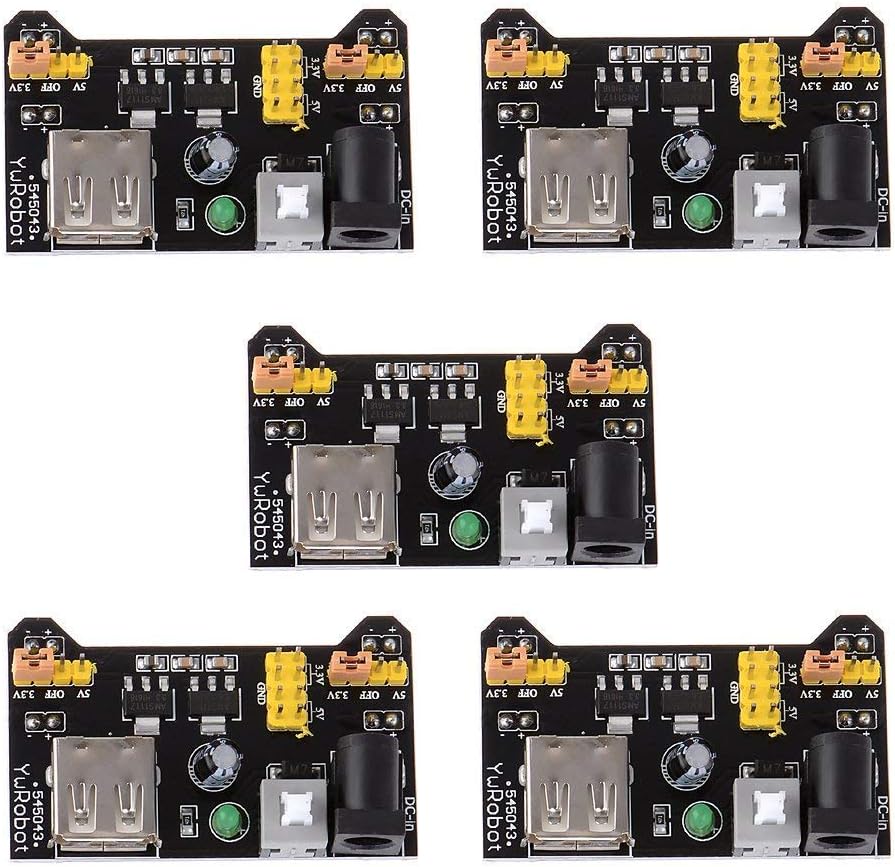
This bundle provides five modules plus connectors for groups or classrooms. Users rate it 4.2 stars for its affordability. It covers standard 3.3V and 5V needs well for small projects.
We may earn a commission when you buy through this link, at no additional cost to you.
The inclusion of nine-volt connectors makes it easy to use with battery boxes. This removes the need to buy separate adapters for portable setups. The plug-and-play design saves setup time.
Its current capacity is limited to under 700mA, so avoid high-draw loads. It is fine for sensors and microcontrollers but not motors. Be mindful of power limits when planning circuits.
Perfect for educational labs, it lets every student have their own supply. It is an excellent entry-level choice when budget and quantity matter most.
Five modules allow multiple stations at a low total price.
Includes connectors to power via 9V batteries easily.
We may earn a commission when you buy through this link, at no additional cost to you.
This kit removes guesswork by including the board, module, and adaptor. It holds a 4.0 rating for offering a complete start package. The included adaptor ensures stability without extra purchases.
We may earn a commission when you buy through this link, at no additional cost to you.
You get an 830-point breadboard that matches the module size perfectly. Jumper wires in various colors help organize your circuits neatly. Everything fits together for a clean workspace setup.
The module is standard with two-way control but limited current. Be sure the adaptor plug fits your region. It works well for basic Arduino and Pi projects.
Students and new hobbyists benefit from the all-in-one nature. It is a reliable choice for learning prototyping without hunting down compatible parts.
Power supply, breadboard, and jumper wires come together.
Includes 12V adaptor to ensure steady input voltage.
We may earn a commission when you buy through this link, at no additional cost to you.
HiLetgo is a familiar name with this five-piece module set. It scores 4.3 stars for consistent performance. The modules fit standard boards and provide stable voltage quickly.
We may earn a commission when you buy through this link, at no additional cost to you.
Onboard pins allow direct wiring for custom setups. This flexibility helps if you need to route power externally. It supports common 3.3V and 5V requirements well.
It is not designed for high current loads exceeding 700mA. Keep in mind the classic USB input rather than newer Type-C. Still, it works reliably for most small electronics.
Workshops and schools favor this pack for its longevity. It is a safe bet for general electronics work where reliability is key.
HiLetgo modules are known for quality and consistency.
Onboard pins allow easy external power routing.
We may earn a commission when you buy through this link, at no additional cost to you.
This unit boasts a 4.6 rating for its seamless integration with MB102 boards. It is often cited as a top value pick. The compact size saves valuable space on your workspace.
We may earn a commission when you buy through this link, at no additional cost to you.
Flexible power options let you use USB or DC input easily. It supports the 3.3V and 5V outputs needed for most sensors. The plug-in design requires no soldering.
While it is a single unit, it meets most prototyping needs well. You might miss the option for multiple channels. It is best for individual projects.
Perfect for makers with tight budgets, it delivers reliable power. It is a smart choice for students needing a quick solution.
Compact design leaves more room for components.
Plug directly into rails for instant power.
We may earn a commission when you buy through this link, at no additional cost to you.
This 5-pack includes battery connectors for mobile setups. It earns 4.5 stars for its practical accessories. The LED indicator clearly shows power status during use.
We may earn a commission when you buy through this link, at no additional cost to you.
The self-locking switch ensures you do not leave it on accidentally. It supports standard boards and delivers stable voltage. Great for groups or classrooms needing multiple stations.
Current is below 700mA, suitable for small electronics only. It may not drive high-power actuators. For learning and testing, it is sufficient.
Users who need battery options appreciate the included cables. It is a convenient choice for portable prototyping projects.
Includes cables for direct 9V battery connection.
LED light provides visual confirmation of active rails.
We may earn a commission when you buy through this link, at no additional cost to you.
This kit combines power supply flexibility with educational soldering. It gets 4.1 stars for its custom outputs. The built-in display helps you confirm voltage settings instantly.
We may earn a commission when you buy through this link, at no additional cost to you.
Adjustable outputs let you tailor voltage to your needs. It supports 3.3V, 5V, and 12V plus adjustable. This reduces wiring errors and saves setup time.
You must solder components yourself which requires skill. It might not suit those seeking plug-and-play. Still, it is great for advanced learners.
Workshops and makerspaces enjoy the customization. It is ideal for users who want full control over their power circuits.
Adjust output levels to match your circuit needs.
Digital display shows exact voltage output.
We may earn a commission when you buy through this link, at no additional cost to you.
BreadVolt delivers strong performance with 1.5A on the 5V rail. It earns 4.5 stars for its reliability. The extra USB port adds modern versatility to your setup.
We may earn a commission when you buy through this link, at no additional cost to you.
It supports independent channels and easy voltage selection. The compact size fits many boards easily. It is ideal for advanced projects needing robust power.
You pay a premium for the higher output and USB features. Ensure your board fits the dimensions before buying. It is a powerful addition for serious makers.
Perfect for robotics and IoT projects, it handles load well. It is the best choice when power headroom is essential.
1.5A output supports high-demand microcontrollers and sensors.
Dedicated USB port for powering external devices.
We may earn a commission when you buy through this link, at no additional cost to you.
This module earns 4.8 stars for its efficiency and input range. It handles 5V to 40V inputs flexibly. Adjustable outputs allow fine-tuning for specialized circuits.
We may earn a commission when you buy through this link, at no additional cost to you.
Switching technology offers better efficiency than linear regulators. It includes multiple fixed outputs plus adjustment. This is a top choice for advanced labs.
Setup may require understanding potentiometers. It is less beginner-friendly. But it offers unmatched flexibility.
Engineers and hobbyists who need custom rails prefer this unit. It is the best high-performance option in this list.
Accepts inputs from 5V to 40V for various sources.
Switching regulators reduce heat and improve stability.
We may earn a commission when you buy through this link, at no additional cost to you.
This adapter acts as a bench power supply with AC input. It gets 4.5 stars for high current and display. Voltage is adjustable from 3V to 24V precisely.
We may earn a commission when you buy through this link, at no additional cost to you.
It supports high-power loads up to 3A and 72W. The LCD shows output in real time. It works for breadboards via included alligator clips.
You need cables to connect it to rails. It is not a plug-in board. But it replaces multiple adapters.
Great for workstations and labs needing one central source. It is best for heavy-duty prototyping and repair work.
3A output handles powerful devices like motors.
LCD monitor shows exact output voltage instantly.
We may earn a commission when you buy through this link, at no additional cost to you.
Choosing the right supply depends on your project needs and workspace setup. These factors help you compare models effectively.
Ensure the supply accepts 6.5V to 12V or USB-C for compatibility. This flexibility allows you to use various adapters or chargers.
Look for units that support both DC and USB inputs for maximum convenience.
Select units offering 3.3V and 5V outputs as these match most microcontrollers. Some models include 12V or adjustable options for broader use.
Choose models with selectable outputs via jumpers or switches for easier configuration.
Check the maximum current rating to ensure it fits your load. Standard modules offer around 700mA but high-power models deliver more.
Select higher current units if you plan to drive motors or LEDs.
Confirm the module fits standard MB102 or similar solderless boards. Some designs are compact and may not cover all rails.
Pick units that sit flush to avoid blocking tie points during testing.
Look for short-circuit and over-current protection to safeguard your components. These features prevent damage during wiring mistakes.
Choose models with built-in protection circuits for safer experimentation.
Consider bundles that include connectors, adapters, or breadboards. These add value and reduce the need for extra purchases.
Opt for kits if you are starting fresh and need all parts together.
Durable PCBs and reliable components ensure consistent performance over time. Check reviews for feedback on heat management and stability.
Prioritize models with positive feedback on longevity and heat resistance.
Compare cost against the features provided like displays or high current. Sometimes paying a little more for better specs is worth it.
Evaluate the overall value including included parts and warranty.
Plug the module into the power rails of your solderless breadboard ensuring the pins align with the positive and negative columns. Connect your power source such as USB or DC adapter to the input jack.
Set the output voltage using the jumper cap or switch to match your components. Turn the power on and verify the LED indicator lights up to confirm it is active.
Monitor for heat or unusual behavior during use and disconnect immediately if needed. Keep the unit clean and avoid spills to maintain long term reliability.
Most Arduino boards work at 5V while ESP32 often uses 3.3V. Choose a power supply that supports both to cover different microcontrollers in your projects.
Standard modules often have limited current below 1A so avoid driving large motors directly. Use a dedicated motor driver and power supply for high load applications.
Newer models support USB-C but older ones may only have micro-USB or DC jacks. Check the product description carefully to confirm input options.
Overloads may cause dim LEDs, voltage drops, or overheating. If the supply feels hot, reduce the load and verify current limits before proceeding.
Yes if the module has built-in regulation to step down to 5V. Ensure the input voltage stays within the specified range like 6.5V to 12V.
Most include short-circuit protection making them safer for learning environments. Always supervise younger students and emphasize safe wiring practices.
Different sensors require specific voltages like 3.3V for ESP32 or 5V for Arduino. Use jumpers to set the correct rail voltage to avoid damage.
With proper care and within limits they can last years. Keep them dry and avoid short circuits to maintain consistent performance.
Our top picks include the Dual Channel module for flexibility, the Universal Module for value, and BreadVolt for high current needs. Each offers distinct advantages depending on your projects.
Focus on input options, current capacity, and safety features when selecting a unit. The best model balances reliability with your specific voltage and power requirements.
Always check the latest prices and availability before buying. Verify the product details match your workspace needs to ensure a smooth prototyping experience.