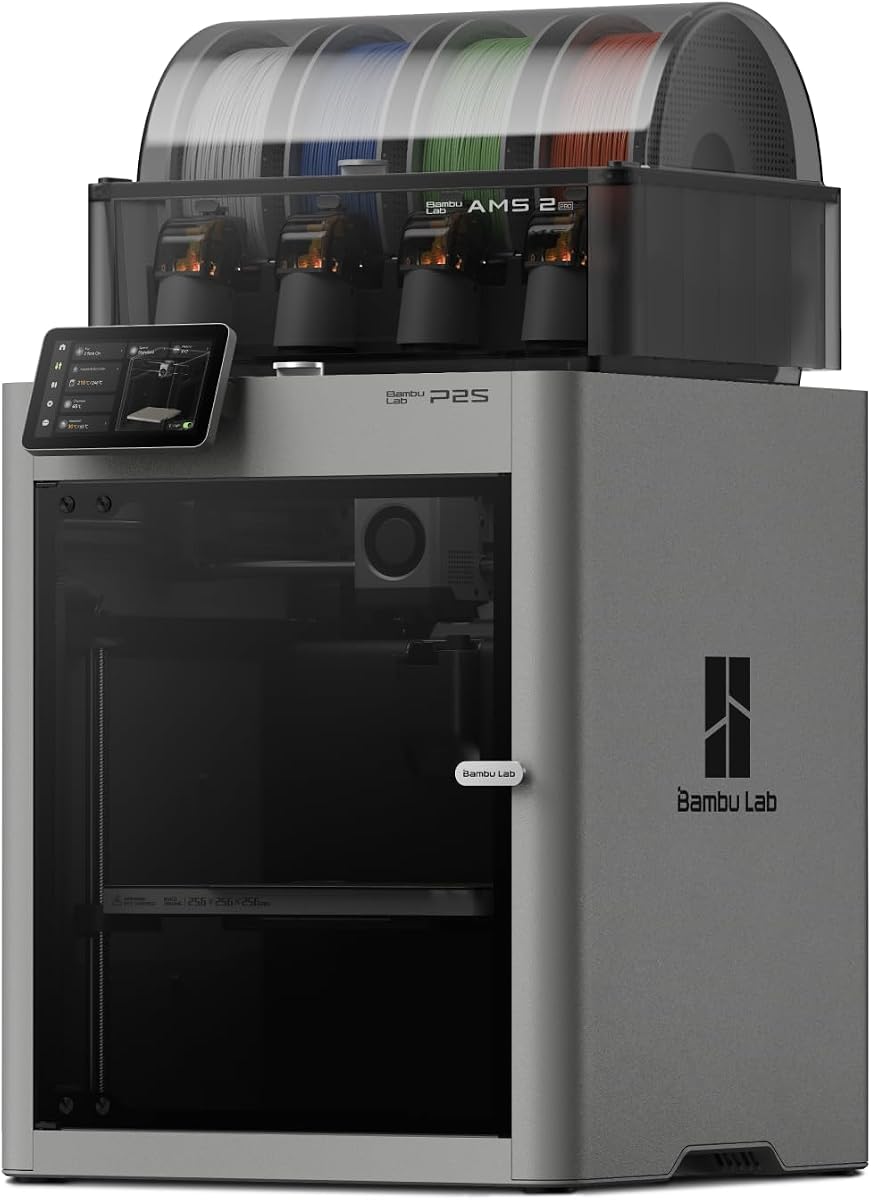
Bambu Lab P2S Combo, P2S 3D Printer & AMS 2 Pro, Multi-Color 3D Printing
4.7Editor score
High-speed precision up to 600 mm/s
Ready to print in 15 minutes
Effortless multi-color printing
Compare the top 3D printers for engineering prototypes. This guide reviews speed, build volume, and material compatibility to help you choose the right
Selecting the right 3D printer for engineering prototypes requires balancing speed, precision, and material versatility. Professionals need machines that handle complex geometries and functional testing without compromising on detail or reliability.
We evaluated leading models based on build volume, print speed, material compatibility, and multi-material capabilities. Our analysis focuses on printers that deliver industrial-grade results for rapid prototyping and functional part verification.
Each pick highlights key strengths for specific engineering needs. Note that prices and availability change frequently, so verify current listings before purchasing to ensure you get the best value for your prototyping workflow.
4.7Editor score

3.5Editor score

4.7Editor score
This side-by-side comparison highlights key specifications across all ten models. Evaluate build volumes, speeds, and material support to find the machine that aligns with your engineering prototyping demands.





The Original Prusa XL stands out as a robust choice for engineering teams needing large-format prototyping capabilities. It offers a spacious build volume that accommodates substantial parts without requiring assembly. The dual toolhead system enables seamless material switching for complex functional prototypes.
We may earn a commission when you buy through this link, at no additional cost to you.
Its CoreXY motion system ensures stable, high-precision printing even during intricate multi-material operations. Engineers benefit from the segmented heated bed which reduces warping and improves adhesion across large surfaces. PrusaSlicer integration streamlines complex printing workflows significantly.
However, users should expect some assembly tasks upon delivery as fragile components arrive separately. The printer does not currently support high-temperature engineering materials as aggressively as some industrial competitors. These are manageable trade-offs for its reliability and workflow efficiency.
This printer is ideal for studios and engineering shops focused on reliable, large-scale multi-material production. If you value a mature ecosystem and lifetime technical support, the XL delivers consistent professional results for prototyping projects.
Intelligent tool switching minimizes purge waste while maintaining high-quality transitions between materials for complex prototypes.
Fully integrated with PrusaSlicer and Printables.com for streamlined multi-material production workflows.
We may earn a commission when you buy through this link, at no additional cost to you.
The Bambu Lab P2S Combo delivers professional-grade speed and precision through its high-performance servo extruder. It is designed to print up to 600 mm/s while maintaining exceptional accuracy and corner quality. Setup is remarkably fast allowing engineering teams to begin work within 15 minutes.
We may earn a commission when you buy through this link, at no additional cost to you.
The AMS 2 Pro enables seamless multi-color and multi-material printing with built-in filament drying. Adaptive airflow ensures crisp overhangs and stable conditions for various engineering filaments. AI failure detection and automatic calibration minimize downtime and manual intervention significantly.
Note that multi-color printing requires the specific Combo configuration to function effectively. While excellent for standard engineering materials, it lacks the extended high-temperature chamber of specialized industrial units. These limitations are minor given its speed and ease of use.
Select this printer if rapid prototyping and multi-material capability are your primary needs. Its user-friendly ecosystem and reliable performance make it a top choice for modern engineering workshops and creative studios.
Prints up to 600 mm/s while maintaining exceptional accuracy and consistent results across all layers.
AMS 2 Pro enables seamless multi-color printing with built-in filament drying up to 65°C.
We may earn a commission when you buy through this link, at no additional cost to you.
The QIDI Max4 Combo offers an ultra-large build volume ideal for printing massive industrial parts and complex molds in one go. It features a powerful 65°C active heated chamber ensuring reliable printing of engineering-grade materials like ABS-CF and PC. Closed-loop motors provide exceptional stability and surface quality.
We may earn a commission when you buy through this link, at no additional cost to you.
Smart monitoring via built-in AI camera detects printing abnormalities instantly to save materials and time. The high-flow hotend supports abrasive materials and industrial-grade filaments with durability. A large touch screen simplifies operation for both professionals and enthusiastic makers.
Users must purchase the Polar Cooler separately to achieve maximum temperature performance. Multi-color printing requires connecting the QIDI BOX separately as it is not included in the base package. These are optional enhancements that maintain flexibility for various workflows.
This machine is perfect for engineers needing large-scale robust prototyping without compromising material versatility. The stability and chamber control make it suitable for producing durable functional parts and testing large assemblies efficiently.
55% larger build volume than predecessor enables printing of large industrial parts in one go.
65°C active heated chamber creates ideal conditions for high-temperature materials like ABS-CF and PC.
We may earn a commission when you buy through this link, at no additional cost to you.
The Snapmaker U1 excels in true multi-material and mixed-material printing with independent toolheads. The SnapSwap system reduces tool change time to just 5 seconds minimizing waste and maximizing productivity. It combines rigid and flexible materials in single prints enabling complex functional prototypes and models.
We may earn a commission when you buy through this link, at no additional cost to you.
Automatic calibration and vibration compensation deliver smooth dimensionally accurate results with minimal manual adjustment. The CoreXY motion system ensures stable high-speed printing up to 500 mm/s. Remote app control and AI monitoring simplify the workflow from setup to finished print.
The compact build volume limits very large single-part prototypes compared to industrial machines. Higher initial costs may be a factor for small teams but operational savings offset this over time. These trade-offs are acceptable for advanced multi-material capabilities.
Choose this printer if you need to print complex multi-material parts like soluble supports or flexible joints efficiently. Its reliability and speed make it a valuable asset for professional creators and small businesses focused on detailed prototypes.
Combines rigid and flexible materials water-soluble supports and engineering materials in a single print.
Automatic tool changer reduces tool change time from around 2 minutes to just 5 seconds.
We may earn a commission when you buy through this link, at no additional cost to you.
The Bambu Lab A1 delivers impressive speed and precision at an accessible price point for prototyping. Acceleration reaches 10,000 mm/s² ensuring fast print times without sacrificing accuracy. Full-auto calibration simplifies setup making it ready to use immediately for engineering testing.
We may earn a commission when you buy through this link, at no additional cost to you.
Active flow rate compensation ensures consistently smooth prints by adjusting extrusion dynamically. Quiet operation allows use in shared workspaces. The 1-Clip quick swap nozzle enables versatile material changes quickly and conveniently for various projects.
Multi-color printing requires the separate AMS lite accessory which adds to the overall cost. It lacks a high-temperature chamber limiting some advanced engineering materials to standard PLA or PETG ranges. These constraints fit well within budget-conscious engineering needs.
Ideal for beginners and small teams needing fast reliable prototyping without significant upfront investment. Its ease of use and speed make it a strong option for iterative design testing and smaller functional parts.
Experience unparalleled speed with 10,000 mm/s² acceleration while maintaining exceptional accuracy.
Say goodbye to manual calibration hassles with automatic Z-offset and bed-leveling processes.
We may earn a commission when you buy through this link, at no additional cost to you.
The FLASHFORGE Creator 5 Pro is designed for industrial engineering with four independent toolheads and near-zero waste technology. It features a fully enclosed active heated chamber up to 65°C enabling confident printing of ABS PC and PA. High-speed CoreXY motion reaches 600 mm/s maintaining accuracy.
We may earn a commission when you buy through this link, at no additional cost to you.
Safety is prioritized with dual HEPA 13 and activated carbon filtration trapping ultrafine particles and fumes. Automated toolhead calibration ensures a flawless first layer every time. Remote monitoring via HD camera and Flash Studio provides full control over the production environment.
The system complexity may require more initial setup and calibration than entry-level options. Operational overhead might be higher depending on filament choices and maintenance needs. These factors are justified for industrial-grade versatility and safety standards.
Select this printer for robust industrial prototyping requiring advanced material handling and safety compliance. Its high throughput and engineering features make it suitable for professional workshops needing reliable multi-material production.
FlashSwap changer eliminates massive purge waste drastically slashing operational overhead and material costs.
Enclosed frame with active heated chamber up to 65°C prevents warping in advanced filaments.
We may earn a commission when you buy through this link, at no additional cost to you.
The Bambu Lab P1S offers a fully enclosed design ideal for advanced filaments like ABS and ASA. It prints at speeds up to 500mm/s with 20000 mm/s² acceleration ensuring rapid prototyping turnaround. Auto bed leveling makes setup effortless and reliable for consistent quality.
We may earn a commission when you buy through this link, at no additional cost to you.
Setup takes about 15 minutes allowing immediate use. The enclosed body improves performance for materials requiring stable thermal conditions. User-friendly design ensures a hassle-free assembly experience for all skill levels in engineering environments.
Multi-color printing requires connecting the AMS separately which increases the total system cost. Carbon fiber reinforced polymers are not recommended limiting specific high-wear industrial prototypes. These are minor constraints given its overall performance.
Choose the P1S for reliable enclosed printing of engineering materials without complex configurations. Its speed and stability make it a strong candidate for rapid iteration and functional testing in professional settings.
Lightning-fast printing speed lets you focus on creating not waiting with 500mm/s capability.
Fully enclosed body improves print performance for advanced filaments and thermal stability.
We may earn a commission when you buy through this link, at no additional cost to you.
The FLASHFORGE Adventurer 5M Pro features an all-metal CoreXY frame reaching speeds up to 600mm/s with precise vibration compensation. It supports high-temperature materials with a 280°C max nozzle temp and 110°C heated bed. Tool-free quick-swap nozzles allow changes in just 3 seconds.
We may earn a commission when you buy through this link, at no additional cost to you.
A fully enclosed chamber with dual filtration ensures a clean environment and thermal stability. Quiet operation under 50dB makes it suitable for office use. Integrated camera and mobile control provide convenient monitoring and alerts for progress tracking.
The build volume is smaller compared to industrial options which limits large single-part prototypes. The control interface is functional but lacks some advanced customization found on more complex machines. These trade-offs fit typical prototyping workflows well.
Ideal for users needing fast reliable printing with minimal interruption for nozzle changes. Its speed and ease of use make it a practical choice for daily prototyping and functional testing needs.
All-metal CoreXY frame enables speeds up to 600mm/s with vibration compensation for precision.
Tool-free quick-release nozzle mechanism allows effortless 3-second replacements across multiple sizes.
We may earn a commission when you buy through this link, at no additional cost to you.
The Anycubic Kobra 3 Max Combo offers an industry-leading 420x420x500mm build volume for life-size prototypes and large parts. It achieves professional precision at 600mm/s speeds with G-sensor vibration compensation to eliminate shifts. Dual-sided PEI spring steel plate ensures excellent adhesion and removal.
We may earn a commission when you buy through this link, at no additional cost to you.
Filament runout sensor and resume function prevent waste from interruptions. The all-metal hotend reaches 300°C supporting a wide range of filaments. Offline printing mode provides flexibility without constant PC dependency for 24/7 reliability.
Software features may be less polished compared to premium competitors with fewer customization options. Noise levels can be higher during high-speed operation affecting quieter workspaces. These limitations are acceptable for the price and volume offered.
Select this model if you need massive build capacity at a budget-friendly price. It is well-suited for engineers and small businesses requiring large prototypes and high-throughput printing without expensive industrial costs.
Professional-grade precision at blazing 600mm/s speeds with G-sensor vibration compensation.
Print life-size prototypes and furniture components on extra-large 3D printer.
We may earn a commission when you buy through this link, at no additional cost to you.
The FLASHFORGE Creator 5 Pro Industrial prioritizes safety with HEPA13 filtration and an active 65°C chamber. Independent extruders allow true multi-color printing without color mixing or cross-contamination. Rigid CoreXY architecture ensures vibration-free precision at 600mm/s speeds.
We may earn a commission when you buy through this link, at no additional cost to you.
Comprehensive sensor suite monitors for filament issues preventing failed prints. Tool-less nozzle changes under 30 seconds simplify maintenance. Flexible PEI magnetic build plate ensures easy part removal and reliable adhesion for engineering projects.
The build volume is smaller than some competitors limiting very large single parts. The premium price reflects its industrial safety features and precision. These are acceptable trade-offs for environments prioritizing safety and material purity.
Ideal for offices and educational settings requiring safe high-performance engineering printing. Its comprehensive monitoring and stable environment make it a trustworthy choice for professional-grade prototyping and production.
Maintains stable temperature up to 65°C ensuring consistent interlayer adhesion and minimizes warping.
HEPA13 filtration effectively captures volatile particles and odors for a cleaner safer environment.
We may earn a commission when you buy through this link, at no additional cost to you.
Choosing the right printer depends on your specific prototyping needs material requirements and budget constraints. This guide covers essential factors to consider before purchasing.
Build volume determines the maximum size of parts you can print without assembly. Engineering projects often require large parts such as automotive components or industrial fixtures. Larger volumes allow for more ambitious prototypes and reduce the need for complex assembly processes.
Ensure the build volume meets your maximum part dimensions with some clearance for support structures. Consider both X, Y, and Z axes to avoid limitations in vertical or horizontal sizes.
Engineering prototypes often require functional materials like ABS ASA PC or nylon that withstand stress and heat. Verify the printer supports the specific filaments you need for your testing requirements. High-temperature capabilities are essential for parts that will face operational stress.
Check for support of specialty materials like carbon fiber reinforced filaments if you need extra durability. Compatibility with soluble supports can simplify complex geometries significantly.
Speed impacts iteration cycles and productivity in engineering workflows. Faster printers allow more designs to be tested within a given timeframe. Acceleration capabilities help maintain quality at higher speeds without sacrificing detail.
Look for machines with high mm/s rates and mm/s² acceleration for efficient prototyping. Balance speed with stability to avoid issues like ringing or layer shifting.
Multi-material printing enables functional prototypes with different properties in one print. This is crucial for testing joints flexible components or colored parts without assembly. Dual or multi-toolhead systems allow seamless switching between materials efficiently.
Consider if you need true multi-material or just multi-color options. Systems that reduce waste and purge time are more sustainable and cost-effective.
An active heated chamber prevents warping for high-temperature engineering materials. It ensures consistent interlayer adhesion and improves print reliability across seasons. Chambers up to 65°C are typical for professional-grade prototyping needs.
Verify if the chamber is actively heated and sealed properly for thermal stability. Insulated designs help maintain consistent temperatures even with rapid door opening.
Slicing software and printer interfaces streamline the workflow from design to print. Integration with common tools like Cura or PrusaSlicer reduces friction for engineers. Remote monitoring and AI failure detection add reliability to long prints.
Choose printers with user-friendly interfaces and active support communities. Regular software updates ensure compatibility with new filaments and features.
Safety is paramount when printing with engineering materials that emit fumes or particles. HEPA and carbon filtration systems protect users from harmful ultrafine particles. Enclosed chambers also contain heat and improve safety in shared workspaces.
Ensure the machine has reliable filtration if used in an office or home environment. Check for certifications and safety sensors like run-out detection.
Reliable technical support minimizes downtime during critical prototyping phases. Manufacturers offering lifetime assistance or professional customer service are preferable. Warranty terms should cover key components like extruders and boards.
Review community resources and documentation availability for troubleshooting. A strong support network ensures your printer remains productive over the long term.
Start by calibrating the bed and Z-offset using the built-in auto-leveling features. Ensure the first layer adheres properly to prevent warping during long prints. Keep the build plate clean and dry for consistent adhesion.
Store filaments in a dry environment to prevent moisture absorption that degrades print quality. Use filament dryers or vacuum sealed bags for materials like nylon. Replace nozzles periodically to maintain precision and flow.
Perform regular maintenance checks on belts rails and motors for smooth operation. Lubricate moving parts as recommended by the manufacturer. Keep firmware updated to access the latest features and stability improvements.
Suitable printers offer large build volumes high material compatibility and consistent precision. Features like active heated chambers and multi-material support are essential for functional testing.
Yes an active heated chamber is highly recommended to prevent warping ensure interlayer adhesion. It allows consistent results especially with larger parts and complex geometries.
Speeds around 500mm/s or higher help reduce prototyping time significantly. Acceleration capabilities ensure maintaining quality at these speeds without sacrificing detail or stability.
Multi-material printing is valuable for testing joints flexible parts or colored assemblies. It simplifies workflows and enables true functional testing without complex post-processing or assembly.
Strong software integration streamlines slicing monitoring and remote control. Look for compatibility with popular slicers and robust cloud features for seamless engineering workflows.
Regular calibration cleaning of build plates and lubrication of rails are essential. Replace nozzles periodically and keep firmware updated to maintain performance and reliability.
Modern engineering printers offer auto-calibration and intuitive interfaces suitable for beginners. Start with simpler materials like PLA before moving to advanced engineering-grade filaments.
Our top picks cover various needs from budget-friendly models to industrial multi-material powerhouses. The Original Prusa XL stands out for large-scale production while the Bambu Lab P2S offers unmatched speed.
Prioritize build volume material compatibility and safety features based on your specific project requirements. Consider total cost of ownership including maintenance and filament waste when budgeting for equipment.
Prices and availability change frequently so verify current listings before purchasing. Check the latest specifications to ensure the printer meets your evolving engineering prototyping demands.