
Askar 71F Flat-Field Telescope
4.9Editor score
Compact lightweight design
Quaduplet air-spaced optics
Versatile visual and imaging use
Compare the top apochromatic refractors for visual astronomy and astrophotography to find the perfect telescope for your observing needs and budget today.
Apochromatic refractors offer sharp views with minimal color fringing. These telescopes use special glass to correct light across the spectrum, making them ideal for both visual observing and detailed imaging of deep sky objects.
We compared ten highly rated models based on optics quality, build durability, and versatility for different users. Our analysis covers triplet designs, focal ratios, and accessories that enhance performance for various astronomical tasks.
Each pick highlights specific strengths like portability or advanced imaging capabilities. Note that product availability and pricing may change frequently, so verify current details before making your final decision on a new scope.
4.9Editor score

4.5Editor score

4.8Editor score
This side-by-side comparison highlights the key optical and mechanical differences across our selected ten models to help you find the best fit for your specific astronomy goals.




This APO OTA apochromatic refractor reveals celestial wonders with precision optics designed for serious observers. It features a 80mm aperture with triplet optics that deliver bright high contrast images ideal for galaxies.
We may earn a commission when you buy through this link, at no additional cost to you.
The triplet apochromatic optics structure effectively improves the blue edge chromatic aberration problem of single ED structure imaging. Users can observe Messier catalog targets with simple difficulty factors while enjoying clear graphic clarity.
While the scope includes a dual speed toothed focus mount reducing vignetting on full frame cameras you may need additional accessories for specific imaging tasks. The weight reduction compared to aluminum is significant for transport.
This is a solid choice for those prioritizing optical quality in an 80mm format. The extinction measures ensure sharp views even under light polluted skies making it a top pick for visual and imaging use.
The air-spaced triple optical design virtually eliminates chromatic aberration for crisp star points.
The magnesium alloy focuser reduces weight significantly making setup easier for portable astronomy.
We may earn a commission when you buy through this link, at no additional cost to you.
This refractor combines genuine FCD1 HOYA extra-low dispersion optical glass with proprietary enhanced multi-layer coatings on all optical surfaces. It produces excellent views filled with stunning details suitable for both beginners and experts.
We may earn a commission when you buy through this link, at no additional cost to you.
The versatile f/6 focal ratio and air-spaced triplet optical design allow users to capture amazing images of the Moon and planets. The retractable dew shield helps keep optics clear during long observing sessions outside.
The front cell is outfitted with push-pull adjustments to get the best collimation for tightest stars which may take patience. USA support based in Arkansas ensures customers can get help if issues arise.
It is a solid choice for those wanting reliable ED optics at a competitive price. The portability makes it perfect for spontaneous stargazing sessions or mounting atop a larger telescope for guiding.
FCD1 HOYA ED glass ensures minimal color fringing for sharp true-to-life color imaging.
The 80mm aperture and f/6 ratio balance light gathering with wide field capabilities perfectly.
We may earn a commission when you buy through this link, at no additional cost to you.
This affordable and high-quality versatile self-flattened OTA is perfect for those seeking a compact setup for deep sky astrophotography. It weighs only 2.5kg including the hoop and dovetail plate making it very easy to carry.
We may earn a commission when you buy through this link, at no additional cost to you.
The entire lens barrel uses high-quality CNC processing technology and the interior is painted with high-quality matte paint to effectively reduce stray light reflection. It can be used for both visual observation and photography.
Convenient for photographic composition and visual observation the focus can be rotated 360 degrees by loosening screws. This feature helps with camera alignment without tube rotation which saves time in the field.
It is a great choice for travelers who need something light yet optically impressive. The quadruplet air-spaced design ensures sharp field results for both visual astronomy and astrophotography.
Weighing only 2.5kg this scope is easy to carry for spontaneous stargazing anywhere.
Designed for both visual observation and photography including bird watching and scenic views.
We may earn a commission when you buy through this link, at no additional cost to you.
This bundle provides an essential field flattener for deep sky astrophotography with its 80mm APO refractor. The SV209 flattener corrects the field making it suitable for full-frame cameras with large target surfaces.
We may earn a commission when you buy through this link, at no additional cost to you.
The focusing seat is made of magnesium alloy material which can reduce weight by more than 20 percent compared to aluminum alloy material of the same specification. It also includes an 180mm dovetail plate for stability.
There are multiple light barriers inside the focusing seat and the inner wall of the lens barrel designed to meet the ultimate pursuit of extinction. This ensures sharp images even in challenging conditions.
Ideal for those wanting a complete imaging solution without buying optics separately the SV209 supports astronomical conventional back focal length. The hollow design makes it easy to operate and set up quickly.
Includes SV209 field flattener to correct curvature and improve edge quality.
Magnesium alloy reduces weight significantly making transport easier for portable setups.
We may earn a commission when you buy through this link, at no additional cost to you.
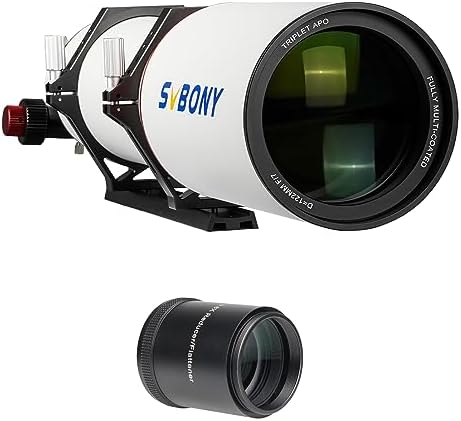
The SV550 APO refractor features a compact 122mm aperture which gathers more light and offers more clear and detailed images. It is suitable for deep sky photography and observation with a higher limiting magnitude.
We may earn a commission when you buy through this link, at no additional cost to you.
The 122mm adopts a FPL-51 triplet apochromatic lens structure which contains one piece of ED glass. This lens provides better correction of aberration and greatly reduces chromatic aberration enhancing clarity and sharpness.
The portable handle and SV211 dovetail base provide a comfortable and convenient carrying handle. After combined installation the large-aperture telescope can be easily carried and moved to dark sky sites.
This bundle simplifies transport with its integrated handle and base making it great for travel. The 122mm aperture offers significant advantages for faint deep sky objects without excessive bulk.
122mm aperture allows capture of fainter deep sky objects effectively.
Portable handle and carrying case make transport easier than standard telescopes.
We may earn a commission when you buy through this link, at no additional cost to you.
This telescope for adults features 102mm aperture and 714mm focal length equipped with FMC coating to improve light transmission and reduce internal reflections. It delivers brighter higher-contrast images for astrophotography and visual observation.
We may earn a commission when you buy through this link, at no additional cost to you.
With its S-FPL51 ED glass this telescope significantly minimizes color fringing for true-to-life color and sharp detail. The dual-speed focuser coupled with a 360 field rotator allows perfect camera alignment without tube rotation.
The 90mm focus travel enables precise focusing even when used with astrophotography accessories such as filter wheels and field flatteners. The aluminum retractable hood actively blocks stray light and prevents dew formation.
It is a great option for visual observers and planetary imaging. The large 102mm aperture ensures light gathering power while the 360 degree rotator simplifies composition.
102mm diameter provides excellent light gathering for brighter deep sky views.
90mm focus travel allows compatibility with various accessories and filters.
We may earn a commission when you buy through this link, at no additional cost to you.
This bundle offers a 122mm aperture which gathers more light and offers more clear and detailed images. The SV209 0.8X focal reducer field flattener is designed specifically for prime focus astrophotography with this refractor.
We may earn a commission when you buy through this link, at no additional cost to you.
The SV209 field flattener can correct the defect of field curvature of the shooting target improving imaging quality. It ensures the edge of the field of view is sharp and suitable for enthusiasts.
The compact refractor features a triplet apochromatic lens structure which contains one piece of ED glass for better correction. It has a higher limiting magnitude suitable for faint deep sky objects.
Ideal for serious photographers this kit provides essential correction optics out of the box. The 122mm aperture provides excellent resolution and light gathering for detailed imaging.
SV209 flattener corrects curvature for sharp edges across the field.
Includes 0.8X reducer for faster imaging and wider field of view.
We may earn a commission when you buy through this link, at no additional cost to you.
The SV550 APO refractor features a 122mm aperture which gathers more light and offers more clear and detailed images. It is suitable for deep sky photography and observation with higher limiting magnitude.
We may earn a commission when you buy through this link, at no additional cost to you.
This kit includes the SV209 0.8X focal reducer field flattener designed for prime focus astrophotography. The field flattener can correct the defect of field curvature improving imaging quality and shooting efficiency.
The SV550 adopts a FPL-51 triplet apochromatic lens structure which contains one piece of ED glass. This triplet lens provides better correction of aberration enhancing clarity and sharpness for stars.
It is a solid package for those wanting a complete setup. The included flattener and base provide convenience and performance for both visual and imaging work.
Includes flattener and base for immediate use upon arrival.
Triplet design ensures sharp star points and high contrast viewing.
We may earn a commission when you buy through this link, at no additional cost to you.
Use this APO OTA apochromatic refractor to reveal the wonders of celestial bodies. You can observe Messier catalog targets such as common shooting targets M42 and M45 with a simple difficulty factor.
We may earn a commission when you buy through this link, at no additional cost to you.
The triplet apochromatic optics structure effectively improves the blue-edge chromatic aberration problem of single-ED structure imaging. Sharp image quality with ultra wide band fully multilayer coated lenses brings you bright and clear images.
SV209 is a special field flattener for SV550 80F6 OTA which can effectively improve the image quality problem of fringe field curvature. It ensures edge detail remains crisp for deep sky photography.
It is an excellent choice for visual and imaging use. The carrying handle and lightweight design make it easy to transport to dark skies for optimal viewing.
FPL51 ED glass and triplet design ensure sharp color-free views.
Comfortable carrying handle improves safety and ease of transport.
We may earn a commission when you buy through this link, at no additional cost to you.
This bundle includes a compact 122mm aperture which gathers more light and offers more clear and detailed images. It comes with SV165 mini guide scope and SV905C telescope camera for complete astrophotography capability.
We may earn a commission when you buy through this link, at no additional cost to you.
The guide camera features a compact and highly sensitive 1.23-megapixel color camera with 1/3 inch CMOS 1280×960 sensor. It has small 3.75-micron pixels and high peak QE of 80 percent allowing tight tracking of faint guide stars.
The SV550 adopts a FPL-51 triplet apochromatic lens structure which contains one piece of ED glass. This triplet lens provides better correction of aberration and greatly reduces chromatic aberration enhancing clarity and sharpness.
Ideal for those wanting a complete package this bundle includes essential tools for guiding. The camera interface is compatible with mainstream auto guiding cameras making setup flexible.
Includes guide scope and camera for immediate astrophotography use.
High sensitivity guide camera ensures precise tracking for long exposures.
We may earn a commission when you buy through this link, at no additional cost to you.
Selecting an apochromatic refractor involves evaluating optical design, aperture size, and build quality to match your observing goals.
Look for triplet or quadruplet air-spaced designs to ensure minimal color fringing. FPL51 or FCD1 glass types offer superior correction compared to standard lenses.
Choose triplet designs for better color correction and sharper star points.
Aperture determines light gathering power and resolution. 80mm is great for portability while 100mm to 120mm offers better detail for fainter objects.
Select an aperture that balances portability with your target objects.
Focal ratios between f/5 and f/7 are ideal for astrophotography providing wide fields. Visual observing may benefit from slightly higher ratios like f/7 for planetary views.
Prioritize f/6 to f/7 for versatile visual and imaging use.
A dual-speed helical focuser ensures precise focus control. Materials like magnesium reduce weight and improve stability during imaging.
Ensure the focuser has smooth operation and supports your camera weight.
For widefield imaging check if a field flattener is included or required. Some bundles include optics that correct curvature for full-frame sensors.
Verify flattener compatibility before buying if you plan to image.
Weight and handle design affect how easily you transport the scope. Consider carrying cases and dovetail plates if you need to move frequently.
Choose lightweight models if you plan to travel often.
Check for included dew shields or carrying handles that add value. Some bundles offer guide scopes which simplify astrophotography setup.
Bundles with accessories offer better value than optics only.
Look for air-spaced lenses to prevent internal reflection. Aluminum or magnesium barrels should be robust and resistant to temperature changes.
Ensure the build is solid for long-term reliability.
Always allow your telescope to acclimate to outside temperatures before observing. This reduces internal air currents that can affect image sharpness.
Use dew shields and heaters to prevent moisture accumulation on optics. Protect the objective lens with caps when not in use.
Clean lenses only with soft brushes or lens cloths when necessary. Avoid touching optical surfaces to prevent scratches and smudges.
Achromatic refractors use two lenses and show some color fringing on bright objects. Apochromatic refractors use three or more lenses with special glass to eliminate almost all color fringing for sharper views.
Yes for astrophotography and critical visual observation. The superior color correction and sharpness justify the cost especially if you want detailed images.
Most factory collimated but adjustments may be needed if bumped. Some models include push-pull screws for precision alignment.
f/6 to f/7 offers a good balance of speed and field of view. These ratios capture large nebulae well without being too fast.
Yes but images will appear inverted. Add a star diagonal or erecting prism for upright terrestrial views.
Yes they are popular for their portability and sharpness. They work well with small to medium sensors and are easier to transport.
Use an equatorial mount with weight capacity exceeding the total setup. Goto mounts simplify tracking for imaging targets.
Use a rocket blower to remove dust first. Apply lens solution to a cloth not directly to the lens and wipe gently in circles.
Our top picks include the SVBONY SV550 AP0 for visual and imaging and the Askar 71F for portability. These models offer excellent optical performance for their price points.
Prioritize optical quality and focal ratio based on your imaging or visual goals. Larger apertures provide better detail but require sturdy mounts.
Check current prices and availability before buying as these can change frequently. Always verify accessory compatibility with your existing gear.