As an Amazon Associate we earn from qualifying purchases. We may earn a commission when you buy through links on this page, at no additional cost to you. Read our affiliate disclosure.As an Amazon Associate we earn from qualifying purchases.Purchases through our links may earn us a commission, at no extra cost to you. Read our affiliate disclosure.
Arduino ADC boards are essential for makers who need to read analog sensors with higher precision than standard microcontroller pins allow. These modules convert continuous voltage signals into digital values that code can process for accurate measurements. Choosing the right board depends on your specific resolution needs, channel count, and communication protocol preferences.
We evaluated ten top-rated analog-to-digital converter modules based on resolution, sampling rates, voltage ranges, and community support. Each product offers unique strengths for different project scales, from simple hobbyist experiments to industrial data logging applications. Our analysis focuses on real-world performance metrics and compatibility with popular development ecosystems.
Every pick includes detailed specifications, pros and cons, and usage scenarios to help you match hardware to your project requirements. Remember that availability and pricing fluctuate frequently so check current listings before finalizing your order. This guide aims to streamline your selection process for reliable analog signal acquisition.
Top 3 Picks for Best Arduino ADC Board
Best Budget
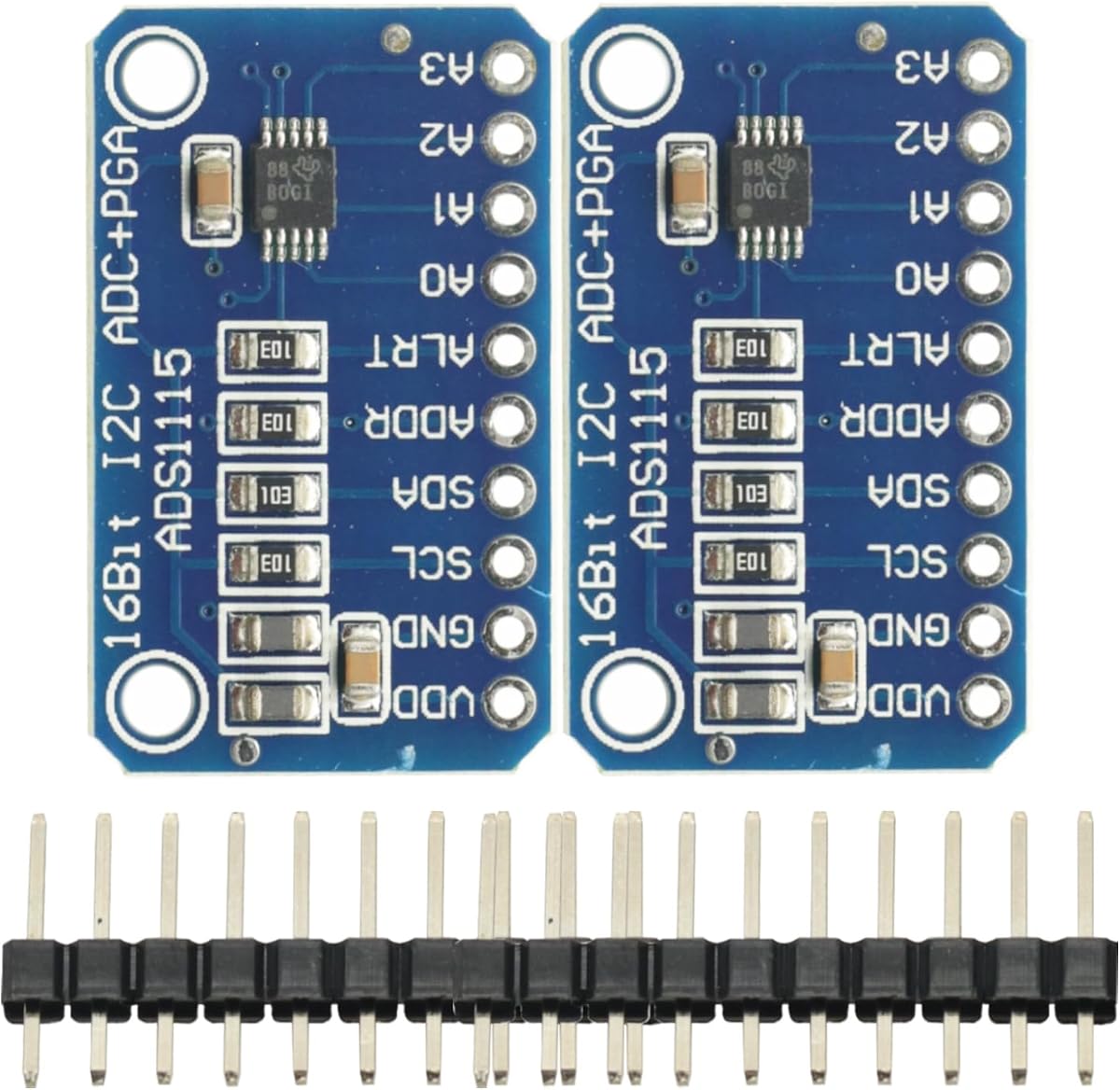
2Pcs ADS1115 16 Bit I2C Module Precision ADC 4 Channel Analog-to-Digital Converter Development Board Pro Gain Amplifier for Arduino Raspberry Pi ADC Module
The following table provides a side-by-side comparison of all ten reviewed ADC modules highlighting key specifications and unique capabilities for quick reference during your selection process.
This ADS1115 module from Teyleten Robot stands out as a top choice for makers needing reliable analog conversion. With a 4.7 star rating it delivers consistent performance across multiple channels while maintaining cost effectiveness for bulk projects.
Pros
High accuracy readings
Multi-pack value
Wide voltage range
Programmable gain
Strong community libraries
Cons
No onboard reference
Requires external headers
We may earn a commission when you buy through this link, at no additional cost to you.
The built-in programmable gain amplifier allows you to amplify weak signals before conversion which is crucial for sensor accuracy. Its four channels support both single-ended and differential configurations making it versatile for various sensor types.
While it lacks an onboard voltage reference requiring careful circuit design for maximum stability its programmable data rate lets you balance speed against power consumption easily. The 16-bit resolution ensures fine granularity in measurements.
Ideal for students and professionals building multi-sensor arrays this pack provides redundancy and flexibility. Its wide supply range ensures compatibility with both 3.3V and 5V logic systems without additional shifters.
High Resolution Advantage
The 16-bit resolution allows detection of voltage changes as small as microvolts when using full gain settings.
Flexible Gain Settings
Programmer gain amplifier ranges from ±0.256V to ±6.144V accommodating diverse signal amplitudes without clipping.
The HiLetgo ADS1256 offers exceptional 24-bit resolution ideal for applications demanding extreme precision like laboratory measurements. Its eight channels provide ample inputs for complex systems without needing multiple boards.
Pros
Very high resolution
Eight input channels
Low nonlinearity error
Onboard reference voltage
Good for precision
Cons
Slower sample rate
SPI wiring complexity
We may earn a commission when you buy through this link, at no additional cost to you.
An onboard 2.5V reference voltage ensures stable baseline measurements reducing drift over time compared to modules relying on external references. This feature significantly improves long-term reliability in data logging scenarios.
Although the maximum 30ksps sample rate is slower than some competitors the tradeoff supports higher resolution and noise reduction. SPI communication requires more pins than I2C but offers faster raw throughput when needed.
Best suited for scientific projects or industrial monitoring where accuracy outweighs speed requirements the ADS1256 excels in steady signal environments. Its low nonlinearity error ensures faithful representation of analog inputs.
Precision Measurement
24-bit resolution provides over 16 million discrete levels for capturing minute voltage fluctuations accurately.
Stable Reference
Onboard 2.5V reference source minimizes measurement drift caused by power supply variations.
Achieving a perfect 5.0 rating this dual pack of ADS1115 modules offers incredible value for budget-conscious makers. The simple I2C interface and comprehensive gain ranges make it accessible even for beginners.
Pros
Perfect 5-star rating
Cost-effective dual pack
Wide input voltage ranges
Simple wiring
Compact form factor
Cons
Basic packaging
Limited documentation
We may earn a commission when you buy through this link, at no additional cost to you.
Seven programmable input ranges allow flexibility when measuring signals from millivolts to several volts. This adaptability means you can use a single module type across diverse projects without specialized hardware.
While documentation is minimal online resources abound for the popular ADS1115 chip ensuring support is available. The compact size fits easily on crowded breadboards allowing neat wiring in constrained spaces.
For prototyping or classroom use where multiple students need individual boards this pack provides convenience and affordability. Its reliable performance and ease of use justify the top rating among users.
Beginner Friendly
Standard I2C pins simplify connections requiring just two wires plus power and ground for basic operation.
Versatile Ranges
Input ranges span from ±0.256V to ±6.144V covering most common sensor output voltages.
This three-pack of ADS1115 modules provides ample hardware for expanding multiple projects simultaneously. The inclusion of a hardware comparator mode enables efficient threshold detection without continuous polling overhead.
Pros
Three unit quantity
Comparator mode feature
Wide voltage supply
Low power mode
Raspberry Pi friendly
Cons
Moderate rating
Basic build quality
We may earn a commission when you buy through this link, at no additional cost to you.
Operating across 2.0V to 5.5V ensures compatibility with varying microcontroller logic levels without additional components. Single-shot mode allows automatic shutdown after conversion saving power in battery-powered deployments.
Though the rating sits at 4.3 stars users appreciate the convenience of bulk supply and straightforward integration with Raspberry Pi GPIOs. The modules lack analog pins on Pi making external ADC essential.
Recommended for makers managing parallel experiments or educational setups needing several identical units this kit offers reliability. Its balance of features and quantity makes it a practical choice for growing collections.
Comparator Functionality
Hardware comparator allows triggering interrupts on voltage thresholds without constant CPU monitoring.
Power Efficiency
Auto shut down in single-shot mode extends battery life in remote monitoring applications.
Offering four modules in one order this pack suits large-scale deployments needing redundant hardware for testing and prototyping. The internal oscillator eliminates the need for external timing components simplifying design.
Pros
Four unit quantity
No external crystal
Internal oscillator stable
Wide voltage support
Affordable pricing
Cons
Basic construction
Limited branding
We may earn a commission when you buy through this link, at no additional cost to you.
Consistent performance across all units ensures uniform data acquisition characteristics which helps in multi-board systems. The I2C interface simplifies wiring allowing easy daisy-chaining with unique address settings.
While build quality is functional rather than premium the functionality meets standard requirements for most hobbyist and educational uses. The affordability per unit makes it attractive for classroom bulk purchases.
Ideal for labs or makers needing spares this bulk option reduces shipping costs and ensures immediate availability for projects. Its core features align well with general-purpose ADC needs.
Another strong ADS1115 variant this dual pack delivers perfect user satisfaction with its straightforward design and clear labeling. Differential input capability enhances noise rejection when measuring low-level signals.
Pros
Excellent rating
Differential inputs
Simple interface
Compact design
Clear markings
Cons
Soldering required
Basic packaging
We may earn a commission when you buy through this link, at no additional cost to you.
The programmable gain amplifier provides adaptability across different sensor types without external op-amps. Four analog channels offer flexibility for multi-point monitoring within a single board footprint.
Users appreciate the clear labeling for pins which reduces wiring errors during prototyping. The compact board size ensures it fits even in tight enclosures for portable devices.
Recommended for those needing two reliable units for backup or parallel projects this module delivers consistent accuracy. Its simplicity makes it a favorite among both beginners and experienced developers.
Noise Rejection
Differential inputs cancel common-mode noise improving signal integrity in electrically noisy environments.
Label Clarity
Clearly marked pins reduce wiring mistakes during initial setup and troubleshooting.
Lonely Binary distinguishes this module with ENIG gold plating improving solderability and oxidation resistance for long-term reliability. Pre-soldered headers save time and reduce assembly errors for immediate use.
Pros
ENIG gold plating
Soldered headers
Chain up to four
RoHS compliant
Broad controller support
Cons
Higher price
Limited quantity
We may earn a commission when you buy through this link, at no additional cost to you.
Support for chaining up to four modules provides 16 total channels on one I2C bus making expansion straightforward. RoHS compliant construction ensures environmentally safe materials suitable for regulated environments.
While premium pricing reflects quality components it remains competitive given the added finishing touches. Extensive library support for C++ MicroPython and CircuitPython accelerates software integration significantly.
Recommended for professional prototypes or educational kits needing durable components this pack offers reliability. Its high-quality finish ensures consistent electrical contact even with repeated plugging.
Durability
ENIG plating resists oxidation maintaining reliable connections over years of storage and use.
Library Support
Official library support simplifies coding across multiple languages and microcontroller platforms.
This AD7606 module delivers simultaneous sampling across eight channels ensuring perfect phase alignment critical for power analysis applications. The 200KHz sampling rate captures rapid signal changes accurately.
Pros
Simultaneous sampling
High sampling rate
8 input channels
Parallel output mode
Wide input range
Cons
Complex wiring
Lower rating
We may earn a commission when you buy through this link, at no additional cost to you.
Input ranges of ±5V or ±10V accommodate industrial signal levels directly without external attenuators. Internal 2.5V reference voltage provides stable baseline conversion independent of external sources.
However the SPI and parallel interface demands significant microcontroller resources and precise timing. This complexity may deter hobbyists but suits experienced engineers needing high-speed synchronized data.
Recommended for industrial monitoring or power quality analysis this module excels where timing synchronization matters. Its high-speed capability justifies the integration effort for professional projects.
Timing Precision
Simultaneous sampling ensures all channels capture data at exact same instant preserving signal relationships.
High Speed
200KHz sampling rate enables detailed waveform analysis of fast transient events.
With a 4.6 rating this four-pack offers robust performance for educational labs needing multiple units. The I2C interface requires minimal pins enabling easy integration into existing microcontroller systems.
Pros
Four modules included
Strong user rating
Easy integration
Wide compatibility
Ideal for sensors
Cons
Generic packaging
No headers
We may earn a commission when you buy through this link, at no additional cost to you.
Compatibility with Arduino Raspberry Pi and ESP32 platforms makes these versatile for diverse student projects. Stable readings ensure consistent learning outcomes across different user skill levels.
The generic packaging keeps costs low though users may need to solder headers. Overall the value and reliability support widespread adoption in classroom environments.
Best for schools or makers needing spares this set provides consistent performance and straightforward setup. Its broad compatibility ensures long-term usefulness across changing project requirements.
Platform Support
Works seamlessly with major microcontroller platforms simplifying software development.
Stable Performance
Consistent readings ensure reliable data across repeated measurements and different conditions.
For users needing just one module this single unit offers a low-cost entry point to precision analog conversion. It shares core specs with multi-pack variants ensuring identical functionality.
Pros
Single unit available
Low price point
Compact size
Wide voltage
Basic features
Cons
No multi-pack value
Basic construction
We may earn a commission when you buy through this link, at no additional cost to you.
The I2C interface and programmable gain amplifier maintain flexibility for various sensor types. Compact dimensions fit easily into small enclosures for portable IoT devices.
While lacking bulk savings it remains ideal for one-off repairs or minimal prototypes requiring an ADC. The simple design reduces failure points ensuring reliable operation in basic tasks.
Recommended for small projects needing analog input without bulk hardware this module delivers essential capabilities. Its affordability makes it accessible for testing new ideas before scaling up.
Compact Design
Small footprint enables integration into space-constrained portable device enclosures.
Low Cost
Single unit pricing lowers barriers to entry for beginners starting ADC projects.
We may earn a commission when you buy through this link, at no additional cost to you.
Buying Guide – How to Choose the Best Arduino ADC Board
Selecting the right ADC board involves weighing resolution, channel count, and compatibility against your project goals. This guide breaks down key factors to consider for informed decisions.
Resolution and Accuracy
Resolution determines how finely the ADC divides the input voltage range into digital values. Higher bit counts like 24-bit provide more precise readings essential for sensors measuring small voltage changes like thermocouples or strain gauges. For general voltage monitoring 16-bit is sufficient and more affordable than 24-bit options. Consider your required measurement granularity when selecting resolution to avoid overspending.
Prioritize higher bit resolution for precision applications and standard 16-bit for general-purpose projects.
Channel Count Requirements
Channels define how many analog signals the board can read simultaneously or sequentially. Single ADCs with one channel work for simple tasks but multi-channel modules support complex systems without external multiplexers. Some modules offer differential inputs which reject common noise improving accuracy in noisy environments. Determine total sensor count before purchase to ensure adequate channel capacity.
Choose channel counts matching your sensor array to minimize wiring complexity.
Communication Protocol
Interface type impacts wiring complexity and speed. I2C uses two wires plus power ground allowing simple connections and daisy-chaining multiple modules on same bus. SPI offers faster data rates but requires more control pins. Some advanced boards support parallel interfaces for fastest acquisition but demand significant microcontroller resources. Match protocol to your microcontroller pin availability and speed needs.
I2C is preferred for simplicity while SPI suits high-speed requirements.
Sampling Rate
Sampling rate specifies how many conversions occur per second affecting ability to track changing signals. Slow rates suit stable measurements like temperature while fast rates are needed for audio or vibration sensing. Some chips support adjustable rates allowing tradeoffs between speed and noise filtering. Ensure maximum rate exceeds your signal bandwidth to prevent aliasing or lost data.
Select sampling rates exceeding your signal frequency to capture dynamic changes accurately.
Voltage Supply Compatibility
Power requirements determine if a board works with your microcontroller voltage level. Boards accepting 2.0V to 5.5V operate safely with 3.3V or 5V systems without level shifters. Narrower ranges might require regulated supplies adding design complexity. Verify logic level tolerance to prevent damage to your microcontroller during communication. Stable supply voltage improves ADC accuracy by reducing noise.
Prioritize wide supply range boards for flexible integration with common logic levels.
Gain and Input Range
Programmable Gain Amplifiers allow scaling small signals to match ADC input ranges improving effective resolution. Boards offering multiple ranges accommodate diverse sensor outputs without external op-amps. Some modules include onboard references stabilizing baseline measurements against supply variations. Ensure input voltage limits exceed your sensor maximums to avoid clipping or damage. Check if gain settings are configurable via software or physical jumpers.
Use PGA features to maximize resolution on low-voltage sensors.
Physical Form and Mounting
Physical size affects placement options in compact enclosures. Modules with headers are ready-to-use while bare boards need soldering. Some offer gold plating improving reliability in repeated plugging scenarios. Ensure pin spacing matches common prototyping boards for easy breadboarding. Robust construction ensures consistent electrical contact over many insertion cycles.
Select mounted boards for convenience or bare boards for custom integration.
Software Support and Libraries
Official libraries simplify integration reducing development time for coding ADC communication. Support across multiple languages like C++ Python ensures flexibility for various users. Community forums provide troubleshooting help for obscure issues. Check if libraries include example sketches for immediate testing and calibration. Well-documented APIs prevent errors during setup and configuration phases.
Prioritize modules with robust library support to streamline coding efforts.
How to Use and Care for Your Arduino ADC Board
Connect power and ground pins first ensuring voltage matches module specifications. Use appropriate decoupling capacitors near power pins to reduce noise affecting readings. Wire SDA and SCL for I2C or MOSI MISO for SPI to compatible microcontroller pins. Install required libraries in your IDE before uploading code to avoid compilation errors.
Calibrate readings using known voltage references to compensate for offset errors in software. Adjust gain and sampling rate settings via library functions to optimize for your specific sensor. Average multiple samples to reduce random noise if high precision is needed for your measurements. Document configuration settings for future replication when troubleshooting or expanding projects.
Store boards in anti-static bags when not in use to prevent electrostatic damage. Avoid physical stress on solder joints especially on modules without headers to prevent breakage. Keep pins clean from oxidation by periodically inspecting contact points before installation. If using bare boards apply conformal coating for protection against moisture in humid environments.
Frequently Asked Questions
What is the main benefit of using an external ADC board with Arduino?
External ADC boards provide higher resolution and channel count than built-in ADCs allowing precise measurement of multiple analog signals simultaneously. They often include features like programmable gain and differential inputs improving accuracy for sensitive sensors beyond native microcontroller capabilities.
Are ADS1115 modules compatible with 3.3V systems?
Yes ADS1115 modules typically support supply voltages from 2.0V to 5.5V making them safe for both 3.3V and 5V logic systems. Ensure logic level tolerance matches your microcontroller to prevent communication errors or damage.
How many ADS1115 modules can I connect on one I2C bus?
You can connect up to four ADS1115 modules on a single I2C bus by configuring their address pins differently. This expands total channels to sixteen for multi-sensor applications without additional wiring complexity.
What is the difference between differential and single-ended inputs?
Differential inputs measure voltage between two pins canceling common noise for improved accuracy. Single-ended inputs measure voltage against a common ground reference. Differential mode is better for noisy environments while single-ended suffices for clean signals.
Do these ADC boards work with Raspberry Pi without extra hardware?
Yes most I2C ADC boards connect directly to Raspberry Pi GPIOs via SDA SCL pins since Pi lacks built-in analog inputs. Ensure correct pull-up resistors are used and libraries are installed for successful data acquisition.
How do I choose between 16-bit and 24-bit ADCs?
Select 16-bit for general purpose voltage measurements and sensor readings where cost matters. Choose 24-bit when extreme precision is required for applications like laboratory instruments or low-level signal analysis where finer granularity is essential.
Final Thoughts on Choosing the Best Arduino ADC Board
The Teyleten Robot ADS1115 pack offers the best overall balance of features and reliability while the HiLetgo ADS1256 excels for precision multi-channel projects. Budget-conscious builders will find value in the dual ADS1115 packs providing essential performance at lower costs.
Prioritize resolution and channel count matching your sensor array before considering interface types. Ensure power requirements align with your microcontroller to avoid compatibility issues. Always verify library support for your chosen development environment.
Prices and availability change frequently so check current listings before purchasing. Verify shipping options and seller ratings for reliable delivery. This guide equips you to select hardware that ensures accurate data acquisition for your projects.