
ASUS Pro WS WRX90E-SAGE SE
3.7Editor score
AMD sTR5 socket support
Seven PCIe 5.0 x16 slots
Server-grade IPMI management
This guide compares the top ASUS Server Motherboard models for workstations and servers, detailing specs, features, and performance to help you choose the
Choosing the right ASUS Server Motherboard is critical for building reliable workstations or enterprise servers. These boards support high-core CPUs, massive RAM, and fast connectivity needed for modern computing tasks.
We evaluated ten models based on socket support, power delivery, expansion slots, and management features. Each product offers unique strengths for different workloads like AI, rendering, or virtualization.
Each pick highlights key specs and real-world suitability. Prices and availability change often, so verify current details before purchasing to ensure you get the best value for your needs.
3.7Editor score

5.0Editor score
4.3Editor score
Below is a detailed side-by-side comparison of all ten ASUS Server Motherboard models. Review the specifications to find the best fit for your CPU, RAM, and expansion requirements.


The ASUS Pro WS WRX90E-SAGE SE is a high-end workstation motherboard designed for AMD Ryzen Threadripper PRO 7000 WX-Series processors. It stands out with seven PCIe 5.0 x16 slots, making it ideal for multi-GPU setups or extensive I/O expansion.
We may earn a commission when you buy through this link, at no additional cost to you.
It features a robust 32 power-stage design with massive cooling solutions for VRM and M.2 slots. The board also includes dual 10Gb LAN ports, four M.2 slots, and support for up to 2TB ECC R-DIMM DDR5 memory.
While the board offers incredible performance, its EEB form factor requires a large chassis. The price point is also steep, though justified for professional workloads needing maximum bandwidth and stability.
Buyers needing top-tier workstation performance for rendering or AI workloads should consider this model. It delivers unmatched expansion and reliability for 24/7 operations.
Seven PCIe 5.0 x16 slots allow for multiple GPUs or high-speed add-in cards without bandwidth bottlenecks.
Dedicated IPMI LAN port and BMC controller enable secure out-of-band system monitoring and control.
We may earn a commission when you buy through this link, at no additional cost to you.
The ASUS Pro WS W890E-SAGE SE is designed for the future of AI computing with Intel Xeon 600 Processors for Workstation. It features exclusive NitroPath DRAM technology to enhance DDR5 memory performance significantly.
We may earn a commission when you buy through this link, at no additional cost to you.
With seven PCIe 5.0 x16 slots and four M.2 slots, this board handles demanding applications effortlessly. Dual Intel E610-XAT2 10Gb LAN ports ensure high-speed networking, while USB4 and 20Gbps Type-C provide versatile connectivity.
Although it shares the large EEB form factor, its thermal and power design ensures stability under heavy loads. The board is rigorously tested for 24/7 operation, validating its reliability for critical workloads.
This motherboard is perfect for AI engineers and data professionals requiring maximum Intel workstation performance. Its advanced features justify the investment for future-proofed computing environments.
Optimized power and connectivity meet the rigorous demands of modern AI model training and inference tasks.
NitroPath DRAM technology improves signal integrity and speed for ECC R-DIMM DDR5 modules.
We may earn a commission when you buy through this link, at no additional cost to you.
The ASUS Pro WS W890-SAGE is a CEB workstation motherboard ready for Intel Xeon 600 Processors for Workstation. It balances performance and size, offering seven PCIe 5.0 x16 slots and robust connectivity options.
We may earn a commission when you buy through this link, at no additional cost to you.
Realtek 10Gb LAN and Intel 2.5Gb LAN provide flexible networking. The board supports up to 2DPC memory overclocking with NitroPath DRAM technology. IPMI expansion card support ensures remote management capabilities.
Its 12+(2+2)+1+2 power stage design delivers stable power. While IPMI is an expansion option rather than onboard, this keeps costs manageable. It is tested for 24/7 operation ensuring long-term reliability.
Ideal for studios needing strong Intel performance without EEB constraints. It offers a versatile platform for AI, content creation, and virtualization with room for growth.
The CEB layout fits more chassis options than EEB, improving deployment flexibility in workstations.
Optional IPMI card support allows tailored remote administration features as needed.
We may earn a commission when you buy through this link, at no additional cost to you.
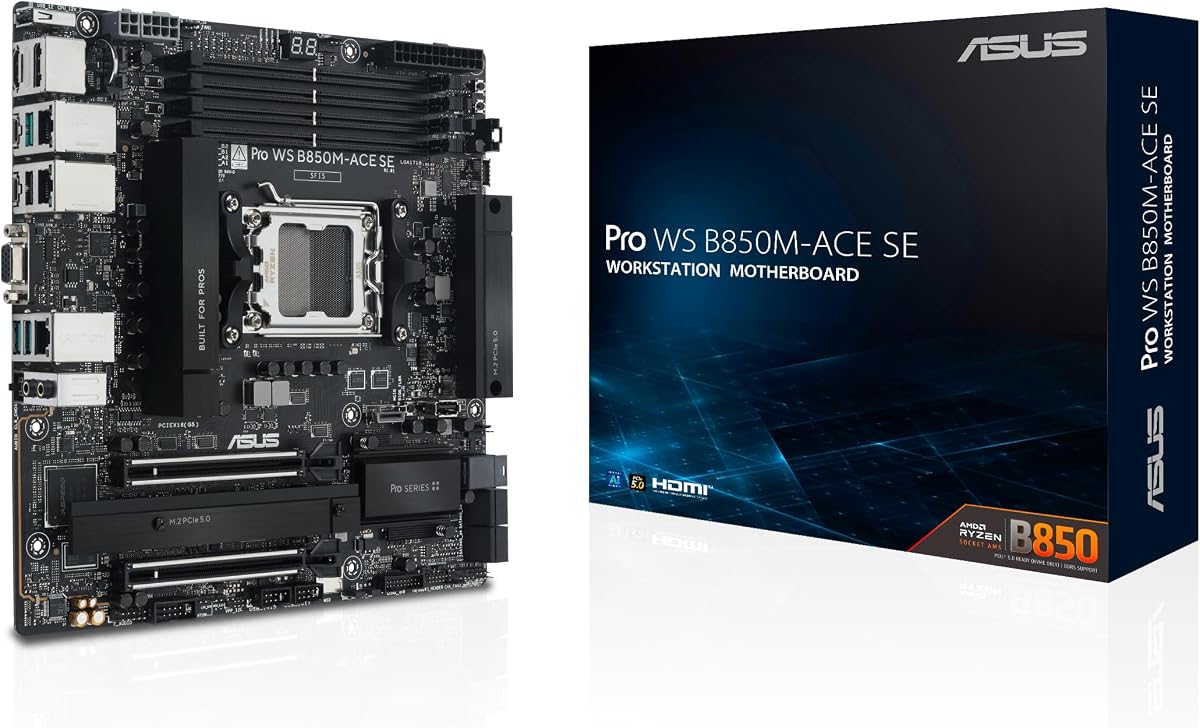
The ASUS Pro WS B850M-ACE SE brings business-grade features to a compact MicroATX form factor. It supports AMD Ryzen 9000/8000/7000 Series and AMD EPYC 4005 Series processors.
We may earn a commission when you buy through this link, at no additional cost to you.
Two PCIe 5.0 M.2 slots and 10G/2.5G LAN offer solid connectivity. The onboard BMC AST2600 enables IPMI remote management without extra cards. USB 20Gbps Type-C ensures fast peripheral support.
Its smaller size suits limited spaces but limits GPU expansion. However, for single-GPU business workstations or small servers, it delivers excellent value and reliability.
Best for cost-conscious businesses needing server management in a desktop-friendly size. It bridges the gap between consumer and enterprise hardware efficiently.
Built-in BMC support allows remote management features without additional PCIe card purchases.
PCIe 5.0 and MCIO ensure readiness for next-gen storage and device speeds.
We may earn a commission when you buy through this link, at no additional cost to you.
The ASUS Pro WS TRX50-SAGE WIFI supports AMD Ryzen Threadripper PRO 7000 WX-Series processors. It integrates WiFi 7 for the latest wireless speeds alongside robust wired LAN options.
We may earn a commission when you buy through this link, at no additional cost to you.
Three PCIe 5.0 x16 slots and three M.2 slots support multiple GPUs and fast storage. It handles up to 1TB ECC R-DIMM DDR5 memory with strong VRM cooling.
While the 36 power stages ensure stability, the cost is moderate compared to EEB boards. IPMI support via expansion cards adds management capability for remote users.
Ideal for professionals needing wireless flexibility without sacrificing workstation power. It suits content creators and engineers requiring both connectivity and performance.
Integrated WiFi 7 provides ultra-fast connectivity for wireless peripherals and network access.
36 power stages deliver stable power delivery for demanding overclocking and high-core CPUs.
We may earn a commission when you buy through this link, at no additional cost to you.
The ASUS Pro WS TRX50-SAGE WiFi A is ready for AMD Ryzen Threadripper PRO 9000 & 7000 WX-Series processors. It provides strong support for AI computing with ample expansion and power.
We may earn a commission when you buy through this link, at no additional cost to you.
It features three PCIe 5.0 x16 slots and USB4 ports for ultra-fast connectivity. The 20 power-stage design and massive cooling ensure reliable performance under heavy loads.
While it lacks onboard IPMI, expansion support is available. It is validated with extensive QVL lists ensuring broad component compatibility for 24/7 operations.
Perfect for engineers needing strong Threadripper performance without maximum premium features. It offers a balanced platform for development and rendering tasks.
USB4 40Gbps ports enable lightning-fast data transfers and daisy-chaining of peripherals.
Massive heatsinks and active cooling maintain low temps during sustained high workloads.
We may earn a commission when you buy through this link, at no additional cost to you.
The ASUS Pro WS W680-ACE IPMI supports 13th Gen Intel Core processors. It includes an IPMI expansion card for enterprise management, making it ideal for secure workstations.
We may earn a commission when you buy through this link, at no additional cost to you.
It features dual PCIe 5.0 Safeslots and 2.5Gb Ethernet. ECC memory support ensures data integrity for critical applications. Thunderbolt 4 headers add versatile high-speed connectivity.
While limited to three M.2 slots, its security features stand out. The bundled IPMI card simplifies deployment for IT managed environments.
Buyers needing secure, managed systems should consider this board. It balances consumer performance with essential enterprise-grade controls.
ECC memory and IPMI management ensure data protection and remote oversight for sensitive work.
Thunderbolt 4 headers provide flexible options for fast external storage and docking stations.
We may earn a commission when you buy through this link, at no additional cost to you.
The Asus P12R-M/10G-2T is an Intel Xeon E-2300 Micro-ATX server motherboard. It is designed for small business servers needing reliability and basic networking.
We may earn a commission when you buy through this link, at no additional cost to you.
Its C252 chipset supports essential server functions. The Micro-ATX format ensures compatibility with standard cases. This board is a practical choice for light server workloads.
While older than newer options, it remains relevant for cost-sensitive deployments. It lacks advanced features but provides core server functionality effectively.
Best for small offices needing a dedicated server without high-end specs. It simplifies IT infrastructure with straightforward hardware.
Supports Xeon E-2300 for stable compute performance in small server environments.
Micro-ATX size allows deployment in small spaces or rack-mounted cases easily.
We may earn a commission when you buy through this link, at no additional cost to you.
The ASUS Z13PE-D16 supports two Intel Xeon 5th Gen processors with LGA 4677 sockets. It offers massive capacity with 16 x DDR5 RDIMM slots for up to 4TB RAM.
We may earn a commission when you buy through this link, at no additional cost to you.
Dual Intel 10Gbps Ethernet ports with teaming support ensure network reliability. Built-in dual M.2 provides fast boot drives. The E-ATX layout fits large chassis designed for server use.
It requires dual power supplies for dual CPU setups. Despite the size, it delivers top server performance for virtualization and databases.
Ideal for enterprise IT needing maximum memory and CPU. It provides robust infrastructure for data-intensive applications.
Supports up to 4TB DDR5 RAM for handling huge datasets and virtual machines.
Dual CPU sockets allow parallel processing power for heavy server workloads.
We may earn a commission when you buy through this link, at no additional cost to you.
The ASUS Pro WS W680-ACE IPMI supports 13th Gen Intel Core processors. It bundles an IPMI expansion card for remote management without extra hardware costs.
We may earn a commission when you buy through this link, at no additional cost to you.
It offers 2.5Gb Ethernet and 3x M.2 slots. Display connectivity includes HDMI, DisplayPort, and VGA for versatile use. The board handles DDR5 memory and offers stability.
While the PCIe slot count is lower, management features are strong. It suits workstations needing remote oversight on a budget.
Buyers needing IPMI without premium pricing should consider this. It delivers essential enterprise features for professional work environments.
Included IPMI expansion card ensures ready-to-use remote management features.
Multiple video outputs allow connection to various monitors for multi-tasking setups.
We may earn a commission when you buy through this link, at no additional cost to you.
Selecting the right motherboard involves balancing CPU, memory, and expansion needs against budget and form factor constraints.
Ensure the board supports your specific processor series. For example, sTR5 is for Threadripper PRO, while LGA 1700 serves Core processors. Mismatched sockets render the board unusable.
Always check official support lists before purchasing to avoid compatibility issues with your chosen CPU.
Server workloads often demand massive RAM. Look for support for ECC R-DIMM DDR5 modules. Some boards support up to 4TB, others less. Consider your long-term needs.
Choose boards with enough slots and bandwidth to handle your database or virtualization tasks without bottlenecks.
Check how many PCIe slots are available and their generation. GPUs and capture cards need x16 slots. PCIe 5.0 offers higher bandwidth than older versions.
Ensure slot configuration supports multi-GPU setups if needed for AI or rendering workflows.
Look for onboard 10Gb LAN if fast networking is crucial. Some boards offer dual ports for teaming. This impacts data transfer speeds to storage or other servers.
Prioritize Ethernet quality for server environments where network reliability is paramount.
IPMI allows remote management which is vital for headless servers. Some boards have onboard BMC, others require expansion cards. Check what is included.
IPMI features simplify maintenance and monitoring especially if the server is in a remote location.
ATX, CEB, and EEB formats differ in size. EEB requires large chassis. Ensure your case fits the board and power supply configuration.
Select a size that fits your physical space while allowing enough cooling airflow.
Check M.2 and U.2 slots for NVMe storage. PCIe 5.0 M.2 provides maximum speed. Some boards also offer SlimSAS for server-grade drives.
Ensure the board has enough fast storage options for your OS and cache requirements.
Server CPUs draw significant power. High power-stage counts ensure stable delivery. Look for robust VRM cooling designs to prevent throttling.
Strong power design is critical for overclocking and sustained performance under heavy loads.
Install the motherboard on standoffs in your case and connect power cables securely. Ensure the CPU cooler is mounted with even pressure to avoid hot spots on the die.
Enable IPMI settings in BIOS to configure remote access. Update BIOS and BMC firmware to the latest versions for security and stability improvements.
Monitor temperatures and fan speeds regularly using ASUS Control Center software. Keep dust filters clean and ensure proper airflow to maintain longevity.
Some boards support both. For example, LGA 1700 supports Core processors. Others like sTR5 only support Threadripper PRO. Check socket compatibility carefully to match your CPU choice.
Yes, most ASUS server and workstation boards support ECC R-DIMM or RDIMM memory. This ensures data integrity and error correction for critical workloads like databases.
IPMI enables remote management of the server including power control and BIOS access. It is essential for headless systems or managing servers off-site without physical access.
Yes, but they are overkill. These boards focus on stability and management rather than gaming features. Consumer boards often cost less for gaming-specific needs.
Most workstation boards lack integrated graphics unless using CPUs with iGPU. Always ensure you have a dedicated GPU if the processor does not support display output.
Download BIOS and BMC updates from the ASUS support page. Use ASUS EZ Flash or BMC web interface for updates. Ensure stable power to avoid corruption during flashing.
Some models include WiFi like the TRX50-SAGE WIFI. Most do not, requiring PCIe cards if wireless connectivity is needed for the server.
ATX boards fit standard cases. EEB and CEB may require workstation chassis. Ensure airflow matches board cooling needs to avoid overheating components.
We covered ten top models from premium EEB boards to budget-friendly MicroATX options. Each provides unique strengths for different computing needs.
Prioritize CPU compatibility and memory capacity first. Then consider expansion slots and management features based on your workflow requirements.
Prices and stock change frequently. Check current availability and details before purchase to ensure you get the exact hardware you need.